

Aspiring Authoritarians Are Often Beaten
In the case of Democracy v. Eroders, the odds favor democracy.


Welcome to What Could Go Right?, where it’s not just the devil who apparently wears Prada.

Longtime readers of this newsletter know that we’ve been on the democracy beat for a while, highlighting cases such as Poland, Brazil, and most recently, Hungary, as would-be authoritarians from Jair Bolsonaro to Viktor Orbán were voted out of office.
These examples are good news in and of themselves, of course. But as a US-based organization, we’re especially interested in them, because . . . well, I don’t think an explanation is really needed, but on the off chance that you’re joining us fresh from a three-year Tibetan Buddhist retreat, please accept this graph of America’s democracy indicators in lieu of one:
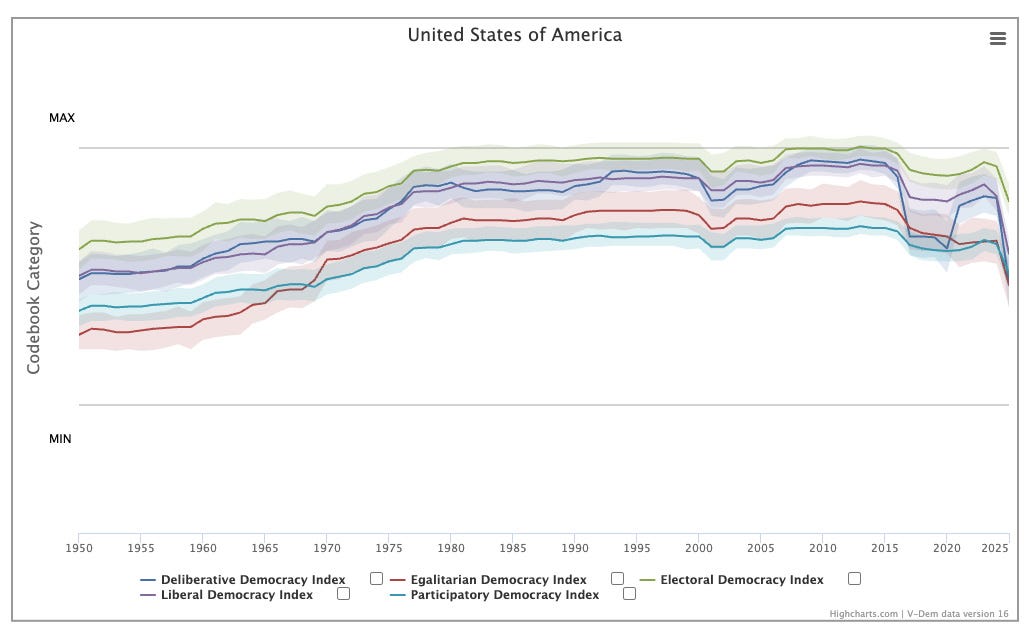
The US is far from the only nation struggling through an anti-democratic period; the world as a whole is experiencing a wave of autocratization. So while the Polish, Brazilian, and Hungarian outcomes were welcome and motivating, they also seemed, at the time, like (happy) surprises. Absent an understanding of what normally happens when a democratic nation is gripped by a leader interested in autocratizing, we could all be forgiven for seeing them as anomalies.
Turns out, though, they are the rule, not the exception.
In the Journal of Democracy, political scientists Javier Corrales and Susan Stokes present their study of “27 instances of democratic erosion” across 22 countries going back to 1999. In the case of Democracy vs. Eroders, the odds are decisively in democracy’s favor: “In 20 instances, leaders left office and did so without completing a transition to authoritarianism,” they write. “Of these 20, 15 were replaced by leaders who either stopped the backsliding or delivered a clear U-turn toward redemocratization.” Of their case studies, only two countries became fully autocratic: Nicaragua and Venezuela.
So what’s the secret to getting an aspiring autocrat to give up power? Corrales and Stokes list four ways it happens, two of which are more common.
The first: elections. Though they may feel like weak sauce as we watch democracies corrode in real time, despite what the cynics say, elections are the most critical lever to pull against autocrats—even when the game is rigged in their favor. The authors cite Poland and Brazil, as well as Botswana, in 2019, Zambia, in 2021, and . . . the US! (I imagine I don’t need to specify which year.)
One crucial factor in elections, as I’ve discussed many times before in this newsletter, is voter turnout. A huge, often historic turnout is key, because it “tends to favor the opposition,” the authors note. I’ve noticed that young people’s enthusiasm, too, is a repeating factor in these renewal stories. Young people flocked to the polls in Poland, Brazil, Hungary, and Zambia, some of these places setting records.
The second weapon against autocratization is term limits. The authors cite six instances, including in Moldova and Ecuador, in which term limits thwarted authoritarian ambitions. What’s more, those who try to change the rules governing them are playing a risky game: in Bolivia, for instance, a national referendum in 2016 rejected then-president Evo Morales' bid to run for an additional term beyond constitutional bounds. Then he ran for reelection, anyway. Needless to say, Bolivians were not amused, and at the behest of the military, Morales resigned as president and went into self-imposed exile. Across the world, the public is wary of leaders who mess with term limits—no doubt a comfort to those worried about the possibility of Trump going for a third.
The less-prevalent paths are party removal—when a political party pressures its own leader to resign—and protests. While protests are important in an autocratizing environment for other reasons, the authors write that they can give leaders an opening to crack down and consolidate power. One interesting side note: they also mention that impeachment is ineffective.
Of course, just because a country successfully dethrones an authoritarian doesn’t guarantee a happy ending. Democratic damage lingers. A decade on from Morales’ exit, for example, Bolivia is in crisis, and the man himself is back in politics.
The dethroning is another chapter of the democratic erosion story, not the end of it—but still, it can be done. In fact, it happens more often than not.
—Emma Varvaloucas
What Could Go Right? S8 E10: Is Free Expression Actually Under Attack? | with Dinaw Mengestu

We hear often that freedom of speech is under threat. And it’s easy to feel like things have never been worse in that regard. But is that really true? Dinaw Mengestu, an acclaimed novelist, MacArthur Genius grant recipient, and president of PEN America, joins host Zachary Karabell to examine the true state of free speech in the United States and abroad. | Listen now
By the Numbers
3X: Increase in parental leave taken by American fathers since 2019
90%: Share of countries that now have laws protecting the rights of people with disabilities
4: Number of US states that prohibit pistols easily converted into machine guns, part of a growing trend
7: Number of US states that have adopted balcony solar, with dozens more considering it
70: Years the black-lored waxbill was lost to science, before posing for its first-ever photos
Go Figure
Few economic sectors are as gimlet-eyed as insurance, which is why believers in science everywhere are cheering recent news from the trade group representing US health insurers. AHIP announced that its members will continue covering routine vaccines through 2027. As anyone with a claims complaint knows, money talks for insurers—and fewer vaccine-preventable diseases means lower hospitalization and death rates.
Quick Hits
🤰 A new blood test can detect thousands of genetic conditions during pregnancy, potentially limiting the need for invasive screening. Scientists say it is safer than amniocentesis and appears to be as accurate, though its reliability is yet to be confirmed.
☀️ Solar generated more electricity than coal in the US for the first time in May. The milestone follows another in March, when renewables overtook gas for the first time.
🗓️ Thirty-three US states will recognize Juneteenth as a legal holiday this year, up from one in 2019. The other 17 recognize it as an observance.
📋 A rare species of flowering plant has been taken off the US Endangered Species List. The northeastern bulrush is the 40th species to be delisted since 2017.
💉 A chemo-free treatment was found astonishingly effective in kids with an aggressive blood cancer and may become the standard of care. The trial’s survival rate was 99%.
📱 Sweden is the latest in a long line of countries to prohibit mobile phones in schools. The national ban is a response to a general decline in younger students’ reading and writing abilities.
🧴 The US has approved the first new sunscreen ingredient in 25 years. Bemotrizinol (BEMT) protects against both UVA and UVB rays and leaves no white residue. Europeans and Asians have had access to it for years.
⚖️ Maryland has introduced automatic voter registration for residents who have completed their felony sentence, and Missouri’s legislature has passed a bill restoring voting rights to some of those individuals. Meanwhile, West Virginia, Kentucky, and Georgia have made it easier for people with a conviction history to attain occupational licenses.
🧠 Startups and scientists are on the hunt for “the perfect trip” as lab-modified psychedelics gain traction. The best-case scenario would preserve therapeutic benefits while modifying adverse effects, from comedowns to heart strain.
🔬 Researchers have identified key genes linked to cocaine use disorder in rats, pointing toward a potential treatment that forefronts the liver—which metabolizes the drug—rather than the brain.
🙅 A proposal to limit Switzerland’s population to 10 million was rejected by voters. The outcome signals an interest to remain close to the EU and a disinterest in hardline immigration policies.
🧂 South Korea has become one of the world’s rare success stories in the tackling of high blood pressure. The secret? Free, mandatory health checks, cheap care, and . . . a government-driven campaign to reduce sodium levels in instant noodles.
📉 Global deaths from intestinal infectious diseases have declined sharply, from 3.69 million in 1990 to 1.27 million in 2023. Much of the reduction came in children under 5, the result of a new rotavirus vaccine.
👩💻 A study in Italy found that remote work wiped out much of the “motherhood penalty,” the earnings loss that often follows having a child. (Related: The Wall Street Journal argues that it’s the “biggest innovation for ambitious women with children since the dishwasher.”)
💬 A city in Uganda is trying something innovative to encourage communication between the public and government: a Youth Desk, a “small but increasingly influential unit within the city administration” where young people line up to air their concerns.
👀 What we’re watching: A highly anticipated, world-first trial to make cells young again—an attempt to treat a form of glaucoma, which causes blindness—has begun.
💡 Editor’s pick: Are we culturally deglobalizing—and is that a good thing?
TPN Member Originals
(Who are our Members? Get to know them.)
Lessons from Platner’s victory | The Renovator | Danielle Allen
AI, at a crossroads | The Edgy Optimist | Zachary Karabell
People are better than we think | Flourishing Friday | Clay Routledge
America on GLP-1s | No Mercy/No Malice | Scott Galloway
Elon Musk is a trillionaire. Why that’s good news for all of us | Faster, Please! | James Pethokoukis
The white identitarians are having a moment | The Atlantic ($) | Thomas Chatterton Williams
An anniversary cage match? America has seen this humiliating spectacle before. | WaPo ($) | Theodore R. Johnson
Election fraud claims in California | Tangle | Isaac Saul