

Citizens’ Army
7 examples of the power of ordinary people


Hello WCGR? readers! I’m still on vacation, but so as not to leave you progress-less for too long, please enjoy the roundup below. – Emma

We spend a lot of time feeling helpless, like we’re watching the world happen rather than actively shaping it. A not-small reason for that: the modern media environment, which both encourages passivity—it’s easier to scroll from home than get our butts in gear—and rarely focuses on regular people.
Turns out, your average Joe is far more involved, and more effective, than the media would have us believe.
Over the past six months, I’ve collected citizens’ army stories—not “army” in the military sense, but in which ordinary citizens, acting together, move the world forward. Obviously, there are countless more, so please share your favorites in the comments.
USA: Citizen Legislators
What if legislation was written by ordinary people instead of politicians, lobbyists, or technocrats? That’s the concept behind a citizens’ assembly, a gathering of 100 randomly selected locals tasked with passing on recommendations for solving particularly thorny issues. They were already being used in countries across the world as well as in some American cities, but never at the state level until Connecticut agreed to convene one this year. In fact, the assembly is scheduled to meet for the first time in just a few days!
What’s on the docket? Taxes, of course. Specifically, of the property variety. In Connecticut, property taxes are the only way to raise money for local services, for which demand is higher in urban areas. That means poorer neighborhoods actually end up paying higher property taxes than wealthier ones. Surprising no one, this issue has been gridlocked since 1972. Regardless of what the people end up doing here, it’s likely we’ll see more such assemblies in the future: Vermont, Maine, Massachusetts, and New York are all interested in hosting their own.
Brazil: Citizen Trailblazers

Imagine hiking through the different regions of beautiful nature in the United States—the red clay of Arizona, the alpine lakes of California, the fir trees of Maine. Now remove all of the trails, and you’d have something not dissimilar to the state of things in Brazil until very recently, where a system of demarcated trails began to emerge only a few years ago. So far, about 22 long-distance trails have been recognized, collectively spanning 4,350 miles, in addition to “hundreds of shorter paths,” reports The Guardian. Another 5,600 miles are coming soon.
The government is involved in this effort, of course, but much of the process has been bottom-up: Trails are marked by local hiking and cycling groups, as well as enterprising business owners who hope the new paths will inspire tourists to visit their area. “New trails are appearing every day,” said Pedro Cunha e Menezes, director of protected areas at the environment ministry.
Australia: Citizen Conservationists

Add the wombat to the list of animals struggling to survive—and of those that humans have gone to great lengths to preserve. Some species of the stumpy marsupials, which live only in Australia, are doing better than others. But all face threats to their survival, from habitat loss, vehicle collisions, and the contagious disease sarcoptic mange, also known as scabies. (Which would be kind of funny if it weren’t for the fact that the poor animals who catch it sometimes scratch themselves to death. I do, however, feel obligated to mention that wombats are polygamous.)
Enter WomSAT, a Western Sydney University project that calls on citizens to record sightings of the animal. As its website explains, “We want to know where the wombats are, if they have mange or not, and if there are burrows nearby.” The information creates a map that helps researchers track mange incidence as well as collision hotspots. Since 2015, citizens have spotted more than 25,000 wombats.
There are endless citizen science stories around animals, by the way, but the wombat one stole my heart. Honorable mention goes to citizen scientists in South Africa, who didn’t know, when they uploaded photos of a “strikingly handsome” moth to the popular website iNaturalist, that their snaps were the first ever of the creature. In February, scientists confirmed it was Drepanogynis insciata, which the world had seen neither palps nor proboscis of since 1875. (By the way, did you know that we are identifying new species now faster than ever before?)
A Planetary System Far, Far Away: Citizen Astronomers
One more citizen science story before we put the genre to bed: NASA has more than 45 projects listed on their citizen science page, and most require only a smartphone or laptop to participate. You can track Martian clouds, locate rare star pairs that orbit one another, or map the trails of molten rock left by asteroid impacts on the Moon’s surface.
My favorite, though, is Planet Hunters, a project on a mission since 2010 to find planets outside of our solar system. Over the years, volunteers have helped to locate over 6,000 exoplanets. What’s especially cool is if any research is published as a result of your efforts, you’re listed as an author of the paper. And, yes, that has happened multiple times. (Imagine adding that fun fact to your Hinge profile!)
One of Planet Hunters’ latest iterations uses imagery from the satellite TESS, which was launched into space aboard a SpaceX rocket in 2018. In May of this year, NASA released its most complete view of the starry sky to date, cobbled together from the 96 sectors of the sky that TESS surveys. The blue dots are exoplanets discovered by TESS, and the orange, candidates yet to be confirmed:

“Over the last eight years, TESS has become a fire hose of exoplanet science,” TESS associate project scientist Rebekah Hounsell told Astrobiology. “It’s helped us find planets of all different sizes, from tiny Mercury-like ones to those larger than Jupiter. Some of them are even in the habitable zone, where liquid water might be possible on the surface, an important factor in our search for life beyond Earth.”
How planets are detected with TESS is where the amateur astronomers come in. Exoplanets can’t be seen with a telescope, because they are hidden by the light of their host star. TESS volunteers monitor “dips” in a star’s lightcurve—what happens when a planet passes in front of a star, and momentarily dims its brightness—to identify them. The Planet Hunters TESS website explains that it is like “us detecting a fruit fly passing just in front of a car headlamp that is located over half way between us and the moon.”
There’s a bit of man-over-machine triumph in this story, too: NASA enlists the public in this endeavor because even their algorithms miss things in the data that the human eye is better equipped to spot.
USA: Citizen Data Divers
When the Trump administration dumped a three-million-document trove of files related to child sex offender and disgraced financier Jeffrey Epstein, it wasn’t just journalists who immediately got to work on it. Hundreds of citizen sleuths took to combing through the “Epstein Library,” too.
A product of the internet age, citizen detectives don’t have the best of reputations. Their list of sins runs long, from confidently identifying wrong perpetrators to—as in the Epstein case —irresponsibly spreading conspiracy theories. But when it comes to the Epstein Library, they’ve also been a help.
Citizen data engineers have built dozens of systems to make the files more easily accessible. In some instances, they’ve provided journalists with actionable information. “A prime example,” notes a piece in The Conversation, “was when open-source intelligence communities successfully cross-referenced early releases of the Epstein flight logs with public charity and event schedules,” thereby mapping out “passenger associations and timelines days before official media could verify them.” Another article mentions a marketer in North Carolina whose Library deep dives are being put to use by a friend lobbying to remove the name of an Epstein associate—and former senator—from an elementary school.
Trust me when I say that I understand there’s a lot to feel cynical about regarding everything to do with the Epstein affair. And as a journalist myself, I empathize with the impulse to ask the public to “leave it to the professionals.” But if you’ll allow me to don my (well-worn) pair of rose-colored glasses, I do find something redeeming in a citizenry so disgusted by Epstein’s crimes—and his circles’ disregard of them—that they refuse to look away, and are willing to excavate hundreds of gigabytes of data to make sure justice is done.
Jamaica: Citizen Tipsters
Speaking of justice, the Caribbean island of Jamaica—not too long ago dubbed the “murder capital of the world”—saw its homicide rate drop a massive 40 percent in 2025. Murders numbered 673, the first time that the total has fallen below 700 since 1993. Jamaica is a small country, so a handful of events can send figures flying in one direction or another. Still, the government believes that ordinary citizens played an important role in securing the island’s recent turn toward stability: Jamaican outlet The Gleaner reports that citizen tips to police have increased nearly tenfold over the past decade, and not because of the reward money. Ninety-four percent of tipsters haven’t come forward to collect it! “It is about patriotism. It is about trust. It is about citizens taking a stand for their communities,” said Jamaica’s deputy prime minister, Horace Chang. Political spin? Maybe. Cause to celebrate? I’d say yes.
France: Citizen Investigators
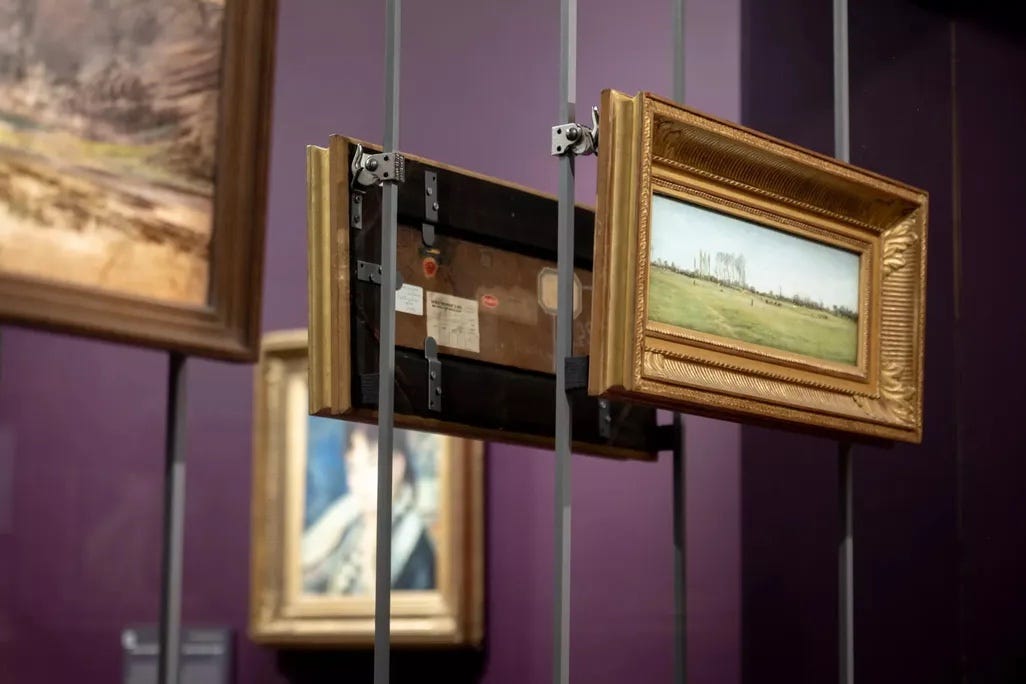
This last entry is one not about what citizens have done, but what museum curators are hoping they will do. In May, Paris’ Musée d’Orsay opened a small exhibition of 13 artworks that were “stolen or sold under duress in France during World War II,” reports The New York Times, part of a larger collection of 225 pieces that will be on rotation. The exhibit aims to continue the work of a restitution project that occurred directly after the war, when a corps of Allies known as the “Monuments Men” ensured the return of tens of thousands of artworks to their rightful owners. (You may remember the movie by the same name, starring Matt Damon.)
Hung with their backs visible so the public can see their “stamps and stickers,” the pieces on display include paintings by Degas and Renoir and a sculpture by Rodin. It does seem a bit far-fetched that just the right person will drop by to figure out whose possession these works belong in, but there’s accompanying funding for a 10-year research project that may yield more fruit.
—Emma Varvaloucas
What Could Go Right? S8 E13: The Case Against Cynicism | with Greg Jackson & Steven Johnson

Despite record highs in life expectancy and historic lows in violent crime, society remains convinced that everything is completely broken. Steven Johnson (The Infernal Machine) and historian Greg Jackson (host of History That Doesn’t Suck) join Zachary Karabell at the Aspen Ideas Festival to decode our cultural doom loop. Rather than fueling the panic of our daily newsfeeds, the panel zeroes in on the psychological and historical roots of our negative worldview, revealing that our current crisis of faith isn’t nearly as unprecedented as it feels. | Listen now