

Ebola Relief
What looks like a worst-case scenario in the DRC masks some silver linings.


Welcome to What Could Go Right?, where we’re curious about whether Donald Trump the man knows about Donald Trump the buffalo.
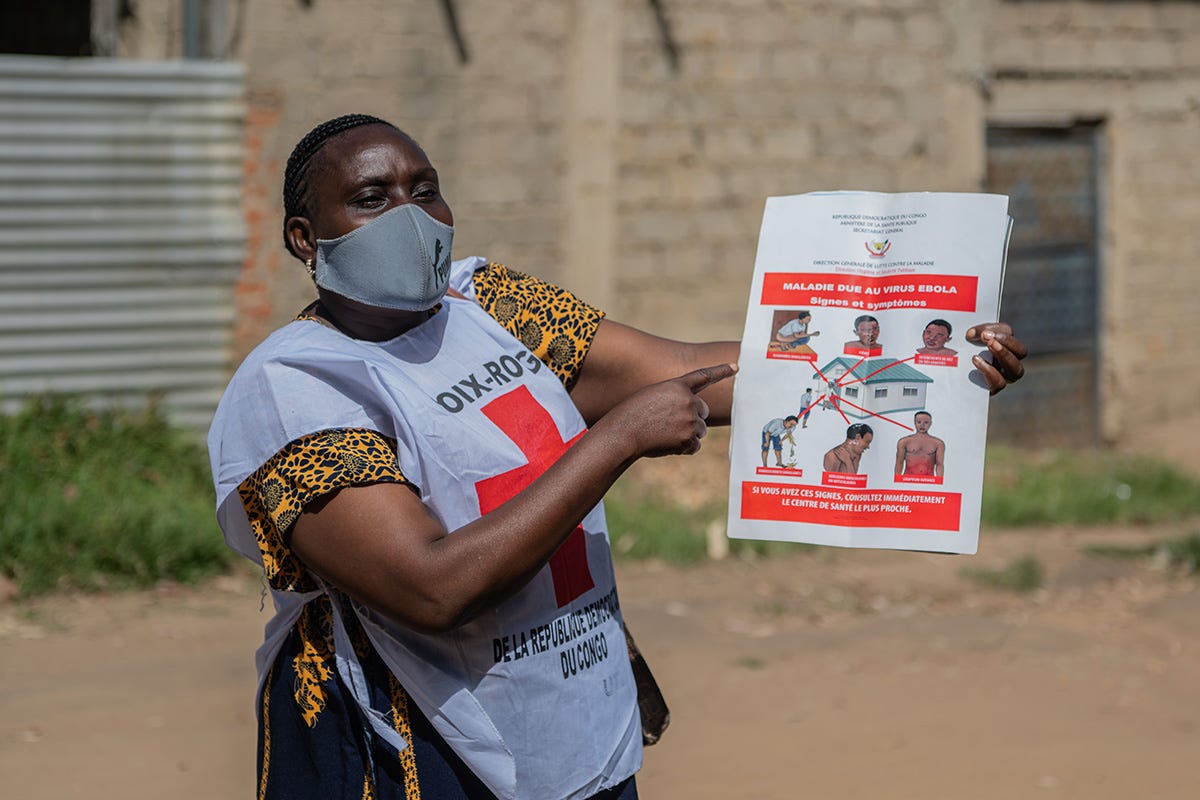
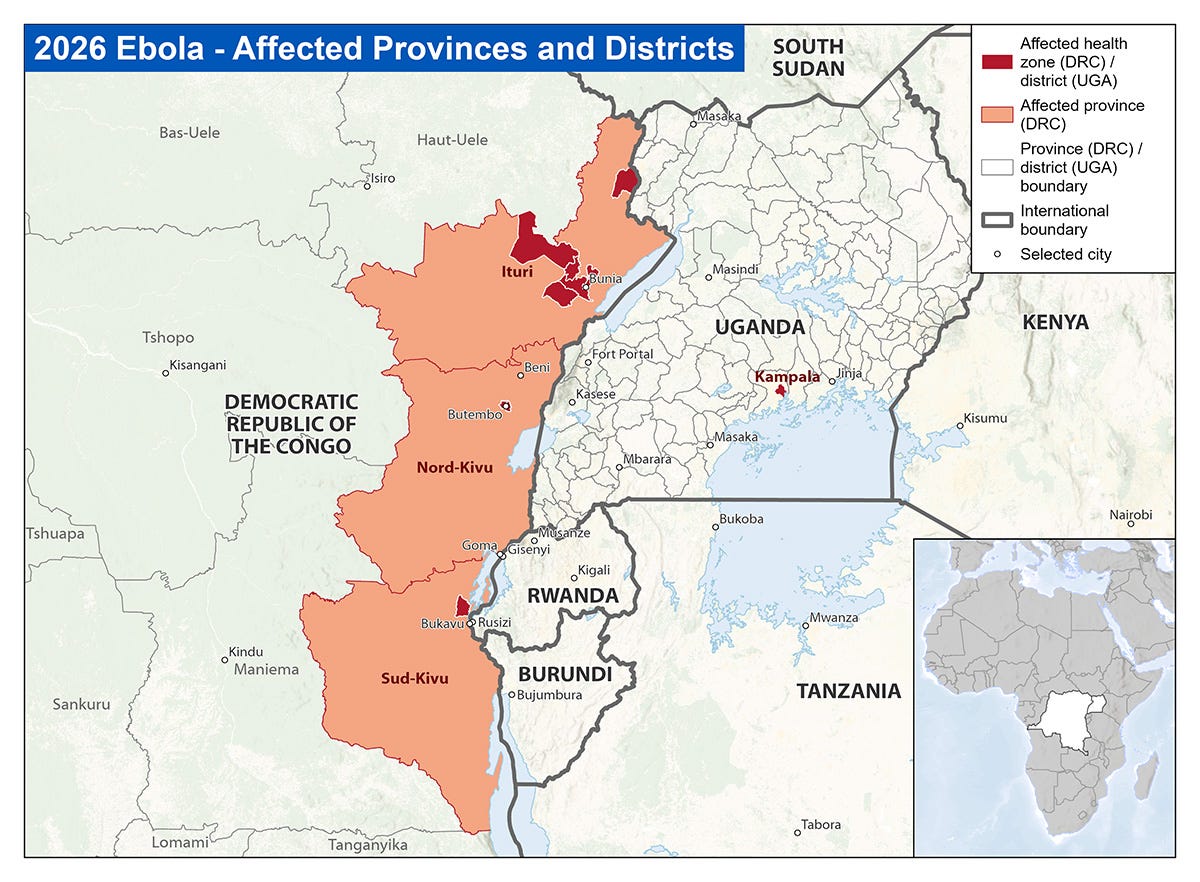
It has not been a good few weeks for global health. Just as the hantavirus situation stabilized, with no deaths reported since May 2, news came of the third-largest Ebola outbreak in history. So far, the World Health Organization (WHO) suspects that more than 200 people in eastern Democratic Republic of Congo (DRC) have died from the virus.
For years, the world’s first Ebola vaccines—which were developed, approved, and stockpiled around 2019–2021—worked so well that I wondered in this newsletter whether the era of large outbreaks was over. As one commenter put it, that take has “aged like milk.”1 I hadn’t counted on the perfect storm that’s going on right now: a rare strain, Bundibugyo, for which no approved vaccine or treatment exists, spreading in a conflict zone with an already deficient healthcare infrastructure that was further gutted by last year’s funding cuts to aid.
So, yes, a lot of factors are working against the speedy containment of the latest scourge. Health officials are further behind the eight ball because the virus had gone undetected for weeks. They do have one thing going for them, though: experience. The New York Times reports that Congo’s health minister, Dr. Samuel-Roger Kamba, “emphasized” in a press conference “that the country had been able to contain 15 previous outbreaks of Ebola without vaccines or treatments.” (Another plus: While Ebola generally has a high fatality rate, the Bundibugyo strain appears to be less deadly than the more common Zaire one.)
The international community has already leapt into action, to turn, as best it can, the situation into a testing ground for Bundibugyo-specific medicines. Alongside the WHO, scientists are working “day and night” to launch clinical trials for two experimental treatments. One is the broad-acting antiviral remdesivir; the other, a two-antibody mix developed for Ebola viruses—and funded by American federal grants for scientific research—called MBP134. It’s as yet unclear whether MBP134 is effective in humans, but it works great in monkeys. Its maker, Mapp Biopharmaceutical, has already shipped over some doses for high-risk individuals.
A few vaccines for Bundibugyo are also in the pipelines of various manufacturers, though none have been tested on humans, and it will take months to prepare them for use. Meanwhile, the Africa Centres for Disease Control and Prevention (Africa CDC) is considering trialing the vaccine that targets the Zaire strain; whether it will act against Bundibugyo is 50/50.
But vaccines or no vaccines, the world is still better prepared than it used to be, Dr. Amanda Rojek, a health emergencies professor at Oxford’s Pandemic Sciences Institute, told CNN. About a decade ago, more than 10,000 people died in western Africa in the largest-ever Ebola outbreak. Compared to then, we now have “ready surveillance systems, faster diagnostics, established ways of running clinical trials, and stronger international coordination.”2 The Africa CDC, for instance, has been catching some criticism for its delayed announcement of the current crisis, but that organization didn’t even exist until 2016.
It will likely take months for officials to put a lid on the spread, so we can expect that the outbreak will continue to grow before it slows. To say that many aspects of the situation are challenging would be an understatement, but those forces are not the only ones in play. And people outside of the regional area should not be especially alarmed; Ebola spreads through close contact. The WHO has set the global risk as “low.”
Before we go: The one-two punch of the hantavirus and Ebola outbreaks makes the annual Epidemics That Didn’t Happen report particularly well-timed. The viruses that break through get the news attention, of course, but no one ever hears when surveillance, detection, and containment work like a charm. For instance, we might well have heard about Ebola back in January 2025, when a nurse in Uganda came down with it, if health officials hadn’t immediately jumped on the case. You can browse all six stories from the report here.
—Emma Varvaloucas
What Could Go Right? S8 E7: The Surprising Ritual Renaissance | with Bruce Feiler

What happens when the traditional ways we gather and mourn start to disappear? Bestselling author Bruce Feiler joins host Zachary Karabell to discuss his latest book, A Time to Gather, and explore the modern celebration recession. Instead of yielding to isolation, Feiler reveals a surprising grassroots renaissance of human connection happening right now. | Listen now
By the Numbers
2017: Year that global sales of combustion-engine cars peaked
26: Miles traveled by NASA’s Perseverance rover on Mars as it continues to collect data (a marathon!)
$25K: Amount that 11 endangered US sites—representing the country’s “promise of equality”—will receive for preservation
$25M: Cost of a cutting-edge maternal care center in Sierra Leone that is expected to curb the country’s maternal mortality rate, one of the highest in the world
>600: Generic drugs added to TrumpRx
Go Figure
Not only does an increasing body of research demonstrate that minimum wage increases do not kill jobs, one recent study showed that such state-level hikes meaningfully reduce poverty and food hardship—across the broader working-age population.
Quick Hits
🐯 A new satellite system can track “animal panic” from space at an unprecedented scale, a useful tool for cracking down on poaching.
⚡ Global electricity generation from wind and solar outpaced gas for the first time in April, according to a new report.
☀️ India is on the verge of being the first major country to industrialize with solar, analysts say, establishing a blueprint for other emerging economies.
🐠 Papua New Guinea is planning to protect a United Kingdom-sized area of its waters, prohibiting all fishing and destructive human behavior within the zone.
🍃 The largest clean energy installation in the US is coming online next month. The New Mexico wind farm will have the capacity to power one million homes annually.
🧑⚖️ Hawaii is poised to become one of the first states to require a judge to consider a child’s exposure to trauma before charging them as an adult. The bill passed without opposition and now awaits the governor’s signature.
🧬 A scientific team is close to performing the first study of in-utero gene therapy, to treat a rare metabolic disorder. It’s currently in talks with the FDA, and go-ahead is expected later this year or early next.
🫁 A couple of individual success stories from the frontiers of medicine: A cystic fibrosis patient from Chicago is in good condition months after receiving a quadruple organ transplant, one of only a handful that have been performed across the US. And, an AI-powered biomedical database saved a newborn’s life.
⚖️ Hungary’s new government has proposed a constitutional amendment to limit the time prime ministers can spend in office. It would, in effect, bar former PM Viktor Orbán from retaking power.
👀 What we’re watching: A July court case will decide whether Botswana becomes the second African nation to achieve marriage equality.
💡 Editor’s pick: The heroic actions of healthcare workers in Africa deserve more attention than they get. (NYT $)
TPN Member Originals
(Who are our Members? Get to know them.)
The saddest countries all speak English | TFP ($) | Arthur Brooks
We’re here to live life, not optimize it | Life with Machines | Baratunde Thurston
Where are the Republicans who put America first? | NYT ($) | Thomas L. Friedman
The DOJ’s anti-weaponization fund | Tangle | Isaac Saul
The price of mythologizing Putin, and some resistance lessons from Ukraine | Lucid | Ruth Ben-Ghiat
How to give a commencement speech about AI without getting booed (too much) | Faster, Please! | James Pethokoukis
Seven ways to avoid losing your job to AI | TFP ($) | Tyler Cowen
Supreme Court’s ‘do nothing’ philosophy threatens voting rights | WaPo ($) | Theodore R. Johnson
Nothing beats polarization like civics education | NYT ($) | Danielle Allen
A black Helen of Troy? Fine. A white Obama? Not yet. | NYT ($) | John McWhorter
The absurd misunderstanding fueling the debate over The Odyssey | The Atlantic ($) | Thomas Chatterton Williams
One take that has held up much better: Take all predictions in the media with a grain (or two or ten) of salt.
The recent hantavirus outbreak is an excellent example: Labs that were members of a 25-country alliance identified the Andes strain within 24 hours of receiving samples of infected passengers from the cruise ship MV Hondius.
thank you!!