

The Great Global Museum Boom
The biggest arts democratization story you’ve never heard


Welcome to What Could Go Right?, where we’re wondering why scientists are suddenly giving fish so many drugs—in the name of research, of course.
Something that gets lost in the inequality discussions that define the zeitgeist in places like the United States is just how much the world as a whole has been equalizing. In the past few decades, while the haves and have-nots kept drifting farther apart at home, the globe was becoming increasingly characterized by an enormous class of have-enoughs, as traditionally poor countries industrialized and became, if not rich, richer.1
Despite what the Notorious B.I.G. had to say about the matter, more money in fact can mean more benefits. There are those much celebrated in progress circles, such as the ones in healthcare, education, and infrastructure. And then there are those that are harder to quantify and so frequently get short shrift, like in culture. Since May 18 is International Museum Day, I figured it was the perfect time to talk about one underdiscussed cultural benefit in particular: the great global museum boom.
It’s a story of mass democratization of the arts that has happened at breakneck speed, and it’s one hardly anyone knows. According to UNESCO, in 1975, there were 22,000 museums worldwide. Today, there are 104,000—an average addition of more than 1,600 new museums per year.
Museums 2.0
Museums have never quite shaken their reputation as existing for the privileged few. First created in Renaissance Europe as a place for royals to show off their collections, by the 20th century, museums were still relatively rare outside of Europe and the Anglosphere, and in many places were considered a relic of colonialism.
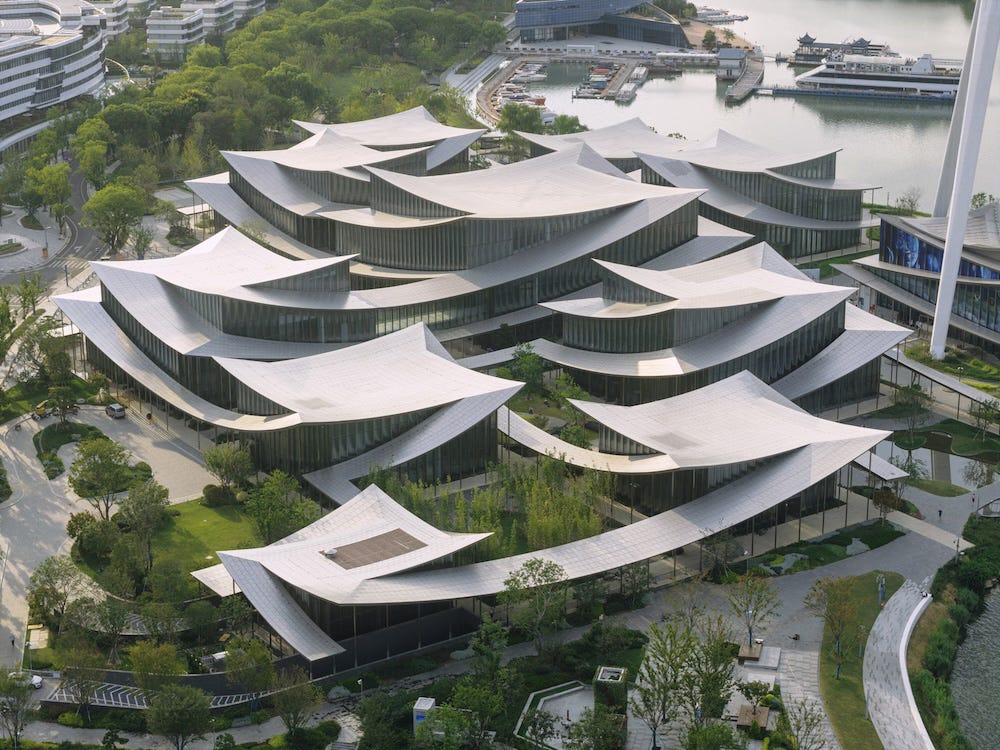
The museum boom was kickstarted in the mid-1970s by Paris’ Centre Pompidou, Europe’s first collection of contemporary art, and continued to surge through the ’90s. But building remained concentrated in areas of the world long accustomed to museum-going. That finally changed this century, when the Middle East, Asia, and South America began to play some serious catch-up.
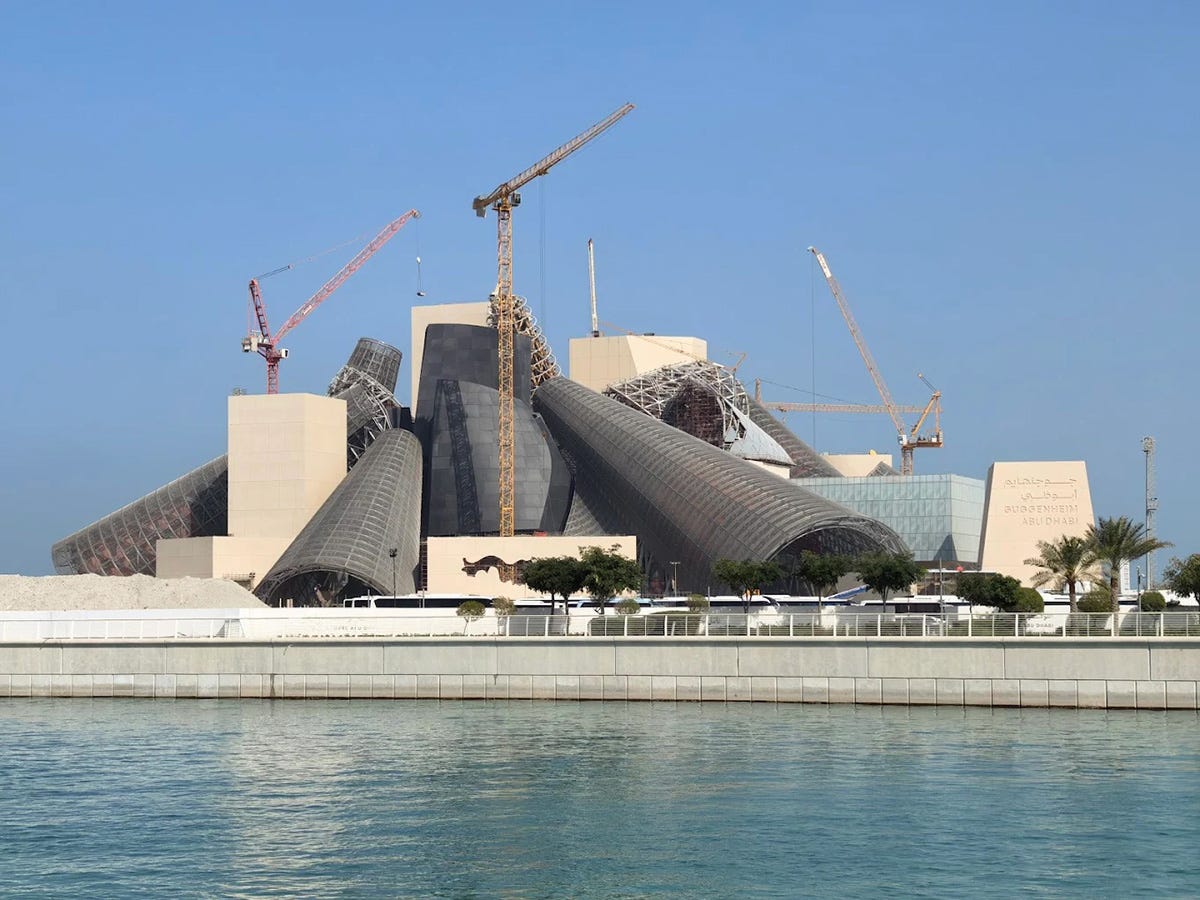
The United Arab Emirates, for example, continues to work on the world’s largest cultural district, Saadiyat Island (“Happiness” Island) off the coast of Abu Dhabi; it is already home to several museums, including an outpost of the Louvre, and Guggenheim Abu Dhabi is set to open this year. Meanwhile, China went on such a spree that between 2010 and 2024 it debuted a new museum every day and a half on average.2
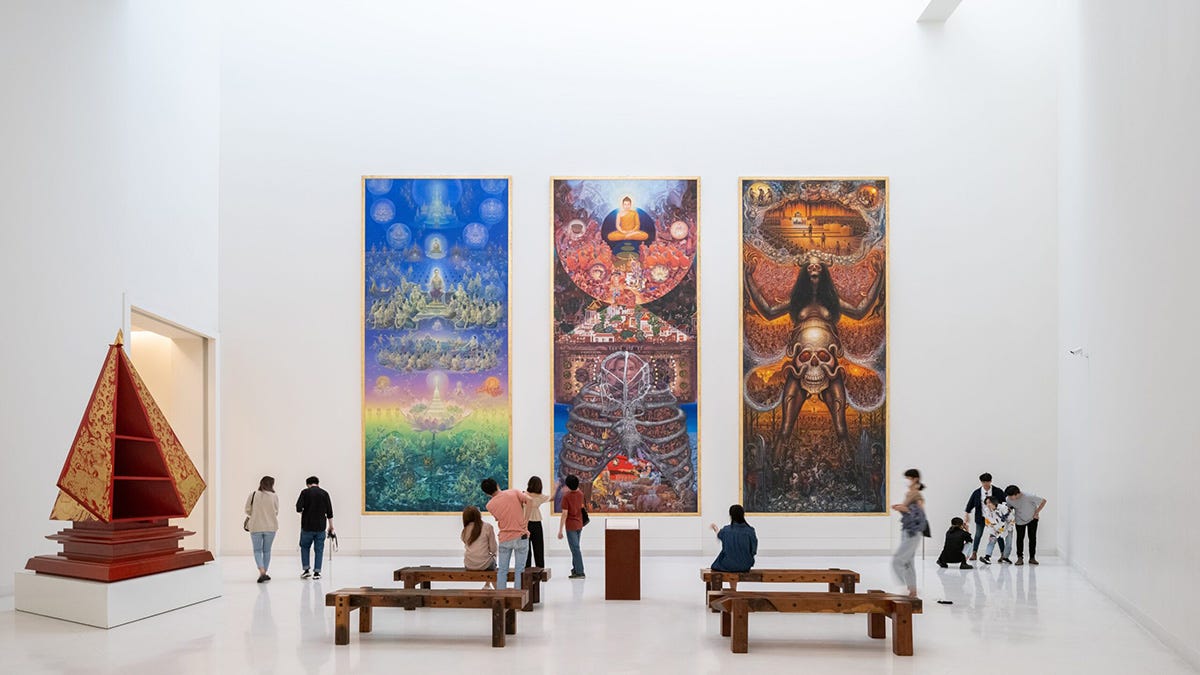
Even governments with considerably fewer resources are joining the parade. The opening of Uzbekistan’s first permanent contemporary arts museum, for instance, was planned for the spring of this year before being delayed by the Iran conflict. And in countries where public investment is limited, private money has filled the gaps. In Southeast Asia, the MAIIAM Contemporary Art Museum in Chiang Mai, Thailand, and the Ilham Gallery in Kuala Lumpur, Malaysia, are just two of the private museums that large-pocketed enthusiasts have bankrolled in recent years; Central Asia just got its first, the Almaty Museum, in Kazakhstan.
Interest is in such boundless supply that it has shaken up most-visited museum lists long dominated by European blockbusters such as the Vatican. After its opening last year, the Grand Egyptian Museum, outside of Cairo, saw numbers that rivaled the British Museum’s, according to The Art Newspaper’s annual visitor-number survey. Mexico City’s Museo Nacional de Antropología, meanwhile, had a record 5.1 million visitors in 2025, edging closer to the Metropolitan Museum of Art in New York, the most popular museum in the Western Hemisphere.3
In general, things are looking good everywhere. After bottoming out during the pandemic, international museum attendance—although it varies country by country and museum by museum—has returned to normal, and even better than normal. “A raft of new museums have opened in the last few years to great success—not just in the Middle East and East Asia, where demand seems almost unlimited,” The Art Newspaper sums up, “but also in highly museum-dense cities like London and New York.” Several more are expected in 2026, including Dataland in Los Angeles, billed as the world’s first museum of AI arts. (Those prone to motion sickness should exercise caution before visiting its website.) This year will also bring a host of special expansions and reopenings, including of the Mosul Museum in Iraq, which ISIS ravaged in 2015.4
Temples of Belief
The democratization element of this great global boom cannot simply be explained by a “more money, more museums” math, though. New and old institutions alike are contributing to a perspective shift that de-centers the West and compensates for the sins of its past. The Guggenheim Abu Dhabi, for instance, focuses on West and South Asian and North African art. And throughout Africa, as a new generation of scholars, artists, and curators presents an alternative history, writes Najlaa El-Ageli, museums are pushing past their reputations as “white elephants, run by eccentric colonialists . . . and primarily visited by foreigners.” Meanwhile, more and more museums are repatriating objects looted during the colonial era and reconsidering presentation and programming influenced by bygone attitudes.5
Bringing together a collection of objects from the past to be passed on has one more particular long-term benefit. As author of The Museum: A Global History Krzysztof Pomian once described them, museums act “as a temple of belief in the future.” That so many more people are visiting those temples than even 10 years ago bodes well.
—Emma Varvaloucas
What Could Go Right? S8 E5: The Case for Not Knowing | with Simone Stolzoff

What happens when our biological need for certainty clashes with an increasingly unpredictable world? Simone Stolzoff, author of How to Not Know, joins host Zachary Karabell to discuss why our modern intolerance for uncertainty is fueling a global anxiety crisis. Rather than seeing the unknown as a threat, Stolzoff argues that uncertainty is the fundamental birthplace of scientific breakthroughs, original art, and human progress. | Listen now
By the Numbers
1: Cost, in euros, of university-student meals in France, now offered to all regardless of income
51: Number of countries that have eliminated maternal and neonatal tetanus since 1999
10%: Colombia’s multidimensional poverty rate, down from 30% in 2010
>45%: Recycling rate in Shanghai, a city leader in China’s move to go zero waste
2032: Germany’s likely exit from coal, earlier than the set deadline
Go Figure
A new study found little evidence that generative AI is reducing artists’ earnings, even as the tech is being used more among creatives than by the broader workforce. Analyzing multiple national datasets, researchers found that artistic occupations especially exposed to large language models have not seen the sharp wage declines many expected.
Quick Hits
🏺 France has passed a landmark law making it easier to return artwork and cultural artifacts taken during the colonial era. Strict prior legislation meant few pieces had ever been repatriated.
📉 Homicides have fallen 40% year-on-year in Jamaica, with the total number falling below 700 for the first time since 1993. Citizen tipsters have made the difference—and they aren’t even collecting the reward money.
☕ Scientists agree: Coffee really is good for you! Its nutritional benefits are increasingly coming to light as quality continues to improve during the era of globalization.
😊 A new technique to treat depression gets at the issue the other way ’round: instead of trying to make people feel less bad, it may work better to make them feel more good.
🌍 Seabed marine life has resurged in Scotland since protections against bottom trawling and dredging were put into place a decade ago.
📉 Violent crime continues to plunge in American cities in early 2026, extending a nationwide decline that began post-pandemic.
🧬 Mounting evidence suggests that a new drug can treat a genetic form of ALS, not just slow its progression—a gamechanger for a disease that usually kills within years.
💊 A hair loss pill that actually works: The results of a late-stage trial were described as a “massive breakaway” from expectations. Existing options cause concerning side effects or don’t last.
⚖️ Maine will begin tracking sexual assault forensic examination kits so that victims can be kept up to date about their status. All 50 states have now enacted rape kit reform laws, slashing the nationwide backlog in half.
💯 Connecticut has mobilized a citizen’s assembly to loosen decades of gridlock around property taxes. The initiative—which tasks 100 randomly selected citizens with shaping public policy—is only the third of its kind convened in the US.
☀️ One of the UK’s largest community-owned solar parks is planning to install battery storage, which would be a first. We didn’t even know this was a thing!
👀 What we’re watching: Brazil is looking to shorten its workweek from six days to five, and Ghana is calling to criminalize “sex for jobs” demands.
💡 Editor’s pick: As Russia stumbles on the battlefield, is Vladimir Putin losing his grip on the country?
TPN Member Originals
(Who are our Members? Get to know them.)
Men teach, too | Of Boys and Men | Richard Reeves
Seniors aren’t living on ‘fixed incomes’ | Slow Boring | Matthew Yglesias
If OPEC falls apart, it’ll cost us all | NYT ($) | Jason Bordoff
The Supreme Court ruling on the Voting Rights Act deregulates democracy | WaPo ($) | Theodore R. Johnson
The Voting Rights Act changed America. Now, it can change. | NYT ($) | John McWhorter
Succession: The Trump drama | Lucid | Ruth Ben-Ghiat
Trust the markets, not the headlines | TFP ($) | Tyler Cowen
The AI boom needs their land | Life with Machines | Baratunde Thurston
The G2 world | Diane Francis | Diane Francis
There’s an argument to be made that the world is more equal today than at any time in history, if you factor in government spending. But purely economically speaking, there is a question of whether this era of “great convergence,” as it’s called, will continue. I discuss both points more in my book, Doomscrolling in the Age of Abundance, which is due out next year, if you’re interested!
Annual visits are now up to 1.5 billion! (It helps that most of the public ones are free; private ones aren’t faring as well.)
If you haven’t been to Mexico’s anthropological museum, I highly recommend it.
Also notable, although an exhibition, not a museum, is Gaza through the lens of its ancient history, on display in Turin, Italy, through September.
Last year, UNESCO also launched its Virtual Museum of Stolen Cultural Objects. A collaboration with INTERPOL, it is designed to draw attention to the issue of illicit artifact trafficking and reestablish access to objects that have been lost. It’s beautifully put together.
This felt surprisingly hopeful to read. At a time when so much art discourse revolves around scarcity and gatekeeping, it’s exciting to see museums expanding globally while also shifting whose histories and perspectives get centered. As someone super interested in feminist art histories and social practice, I keep thinking about who gets archived, preserved, and made visible inside these institutions. “Temples of belief in the future” really stayed with me.!