

Dads’ Quiet Revolution
Something surprising triggered a massive priority shift.


Welcome to What Could Go Right?, where even we have to admit that sometimes the “height of human folly” Hollywood scripts write themselves.

The 1970s and ’80s were a transformational period for the American household. As women increasingly exited the traditional role of housewife and entered the workforce for good, the time that women and men spent working versus homemaking began to converge. By 1992, the gender gap in hours spent at a formal job had shrunk nearly in half.
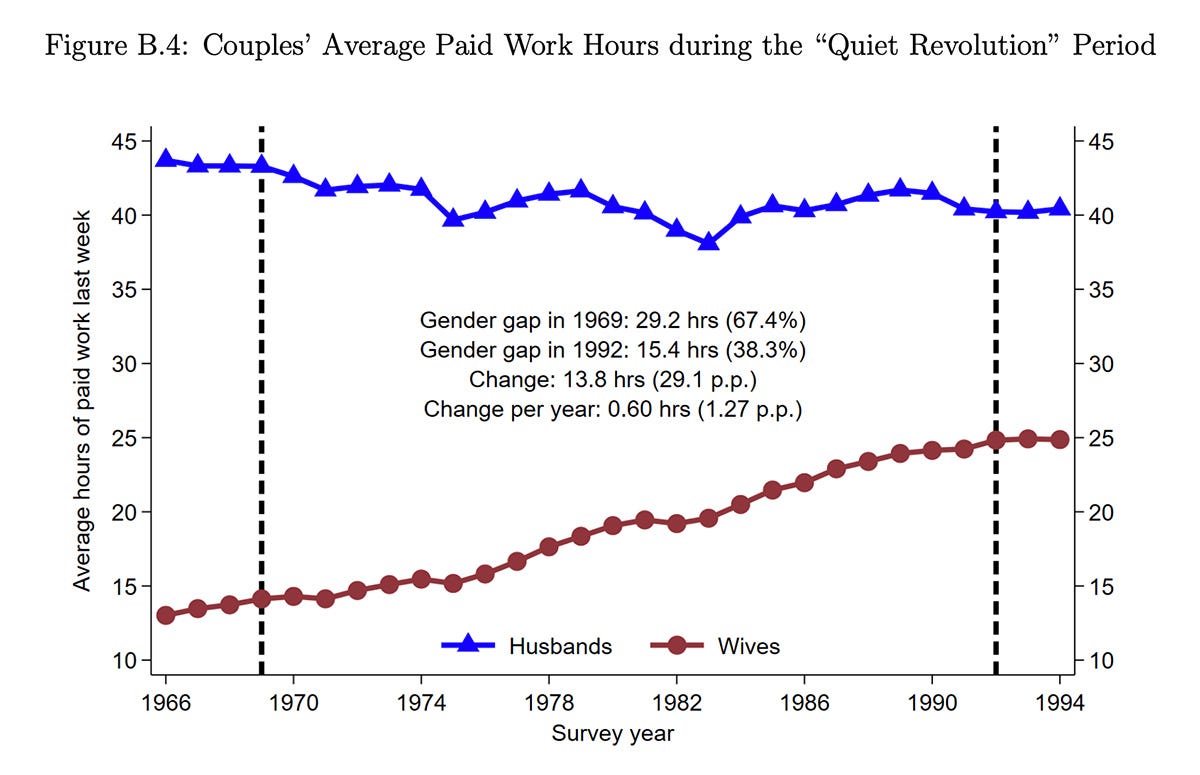
Famously dubbed the “quiet revolution,” this era was unique both because of its rapid pace of change and the novel shift in women’s identities. For the first time, they could be a wife and mother and a careerist.
But the workplace vs. household time convergence between the genders never quite, erm, reached equilibrium. Though it did continue into the millennium—albeit more slowly—by the late 2010s, it had largely stopped.
Then the pandemic happened.
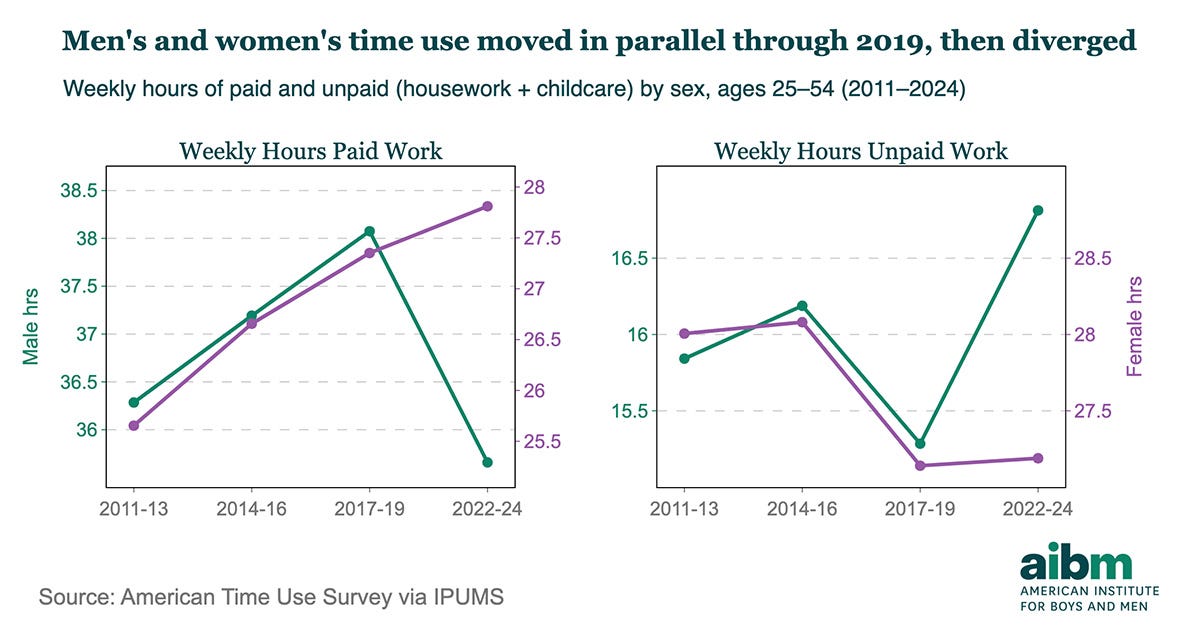
In a new paper, Ariel Binder, a research fellow at the American Institute for Boys and Men (AIBM), documents a shift during the Covid years that was even speedier than the quiet revolution’s. This time, however, it’s not women working more that has driven the trend. It’s men working less (and for fathers in particular, increasing time spent on cooking, cleaning, and childcare). The change is especially stark among college-educated fathers, who between 2019 and 2024 “cut their paid work hours by six per week and raised housework and childcare by more than four.”
As Richard Reeves, a member of The Progress Network and president of AIBM, put it on a podcast, this is the “biggest increase in the amount of hands-on fathering . . . in half a century.” Millennial dads now spend as much time taking care of their kids as moms did in 1985.
After reading all that, I suspect you may have some hypotheses about what’s going on. Perhaps it’s an economic difficulty story: Men today struggle to find employment, and less time working is just the unfortunate byproduct. Or perhaps, more positively, it’s about improved work-life balance, after the pandemic shot remote working into the stratosphere. No commute equals more time with junior.
Those are good theories—and wrong ones. Binder’s number crunching found that those factors explain “very little.” And while it’s too early to say for sure what his findings do mean—and even whether the trend will persist—what they are consistent with is a massive voluntary realignment of gender norms. Non-college educated men, for instance, whose working hours declined less than those of college-educated ones, pulled their extra housework time from that spent previously on relaxation and leisure. Men may be living a quiet revolution of their own: from breadwinner to the now more strongly valued identities of husband and father.
Pondering American fatherhood’s transformation since the Silent Generation, economic analyst Aziz Sunderji writes that it “might seem like a violation of tradition.” But, he argues, “The working-husband-and-housewife norm is not a biological inscription in our genes. It is an invention of the Industrial Revolution.” Neither is it a strictly American development. As Sunderji notes, fathers’ childcare time is “surging” across Europe and in other rich countries, too.
Indeed, it’s telling that Binder found that the most well-off fathers—those with the resources and flexibility to decide how to spend their time—increased homemaking hours most. Dads seem to be more involved in family life now more than ever because they want to be.
Future research will have to answer some lingering questions, but I am especially curious what it was about the pandemic, if not remote work, that triggered such a priority readjustment. Was it the crisis of childcare caused by the lockdowns? Our close brush with mortality? Something else? Let me know your theories in the comments.
—Emma Varvaloucas
P.S. Did you know this newsletter exists in podcast form as well? Catch our latest episode here. Two centuries after France’s second colonial period began, the government is finally letting art and artifacts looted from its former colonies go home.
What Could Go Right? S8 E6: Real Progress: Why We Ignore How Good We Have It | with Nick Gillespie

Why does historic abundance breed widespread cultural anger? Nick Gillespie, editor-at-large of Reason magazine and host of the Reason podcast, joins host Zachary Karabell to unpack the great conundrum of the 21st century: why humans have more security and financial means than ever before, yet feel increasingly dissatisfied. | Listen now
By the Numbers
31: Countries that have eliminated the eye disease trachoma; Tunisia is the latest
40%: Worldwide drop in new HIV infections between 2010 and 2024
52.7%: Share of EVs exported from China in April, surpassing traditional cars for the first time (WSJ $)
100: Number of dams removed in the US last year, reconnecting nearly 5,000 miles of waterways—a record
Go Figure
Acupuncture in many societies occupies an uneasy space between age-old wisdom and modern eye-rolling. Now comes news of the “interstitium,” a fluid-filled connective-tissue network that may function as a third circulatory system (in addition to the cardiovascular and lymphatic systems). Sometimes progress means discovering something new—and sometimes it means admitting the ancients knew it all along. (NYT $)
Quick Hits
💊 A drug treatment for pancreatic cancer is the first to substantially extend the lives of patients—and its novel approach may work for other cancers, too. The manufacturer is now trying to make it freely available to certain patients.
🌲 Brazil has begun to officially mark protected land for the Kawahiva people, an uncontacted, nomadic Amazon tribe whose survival has been threatened by armed groups interested in illegal mining, logging, and other activities. (Related: Deforestation rates in Brazil, while still outrageous, are at a 40-year low.)
👁️ Scientists have managed to get mouse eyes to photosynthesize, a process that could one day help soothe ocular maladies such as dry-eye disease. “This is very exciting, even if it’s a bit crazy now,” the study’s co-author said.
🏠 More zoomers are buying homes, outpacing even millennials. The share, though still small, is growing, and buyers are less likely to use help from parents.
🚫 Virginia has banned the sale and manufacture of certain semi-automatic firearms, joining 11 other states. Lawsuits loom, but similar legislation has survived court challenges in the past.
⚖️ As the topic becomes less taboo, 26 US states since 2019 have enacted menopause laws, which run the gamut from mandating insurance coverage for treatments to workplace accommodations.
🙅 Oklahoma is now the 17th state to ban child marriage. There has been a sea change regarding the issue in the US over the past decade.
🍟 The prevalence and effectiveness of GLP-1 weight loss drugs is forcing fast food joints to rethink menus. With restaurant visits down, some companies are shrinking portions and promoting healthier options. (WSJ $)
🧬 A small study suggests that a single infusion could suppress HIV for years, using the same immunotherapy technique that works against blood cancers like leukemia.
🪱 A new, better treatment for the neglected tropical disease river blindness has begun its real-world rollout. What’s more, the drug was developed by a nonprofit.
🛰️ A combination of satellites and AI is allowing poverty researchers to gather accurate data down to the municipal level. It’s a valuable alternative to surveys that can be too expensive or too slow.
👀 What we’re watching: A bill just passed in Hawaii is a shot at limiting “dark money” in American politics while sidestepping the Supreme Court decision in Citizens United that legitimized corporate personhood.
💡 Editor’s pick: The worst-case climate scenario is dead. What does that mean?
TPN Member Originals
(Who are our Members? Get to know them.)
Pay attention: Essential advice for the class of 2026 | The Atlantic ($) | Jonathan Haidt
Inside the mind of an internet troll | TFP ($) | Arthur Brooks
Trump’s China pragmatism is welcome | WaPo ($) | Fareed Zakaria
Shmoderation is the future | Slow Boring | Matthew Yglesias
NATO, please help. Trump has no strategy for Iran. | NYT ($) | Thomas L. Friedman
Apocalypse no: The AI jobs narrative is BS | No Mercy/No Malice | Scott Galloway
Are we ready for a new voting rights movement? | The Renovator | Danielle Allen
Something big is happening on campus | The Atlantic ($) | David Brooks
My dad gave me three pieces of advice. This one surprised me. | WaPo ($) | Theodore R. Johnson
In my friend group, all the dads are the cooks. My husband does all the cooking and grocery shopping. When we have friends over, I usually look around and notice the men are in the kitchen cooking and I am sitting on the couch chatting with my lady friends, and watching children. It's pretty great.
Hurray for these engaged dads! I am delighted to see dads pushing strollers and watching their children in the park, and to hear about sharing household responsibilities.
One thing that saddens me immensely is also seeing many dads, as well as moms looking at their cell phones while pushing a stroller, while their little ones play, and while at restaurants for a supposed family meal. Sometimes the whole family is looking at their cell phones. Who knows how much screen time is happening at home. It won't really matter whether it's mom or dad at home if relationships aren't being nurtured.
My best wishes to families who want to parent thoughtfully in the ever present technology surrounding us!
Nancy N. Vancouver, B.C.