

The World Is Much Less Murderous
We're literally aging out of killing one another.


Welcome to What Could Go Right?, where grand technological innovation has done it once again: Fitbit for farts, coming soon to a boxer brief near you.

By now, you’ve doubtless heard the president claim that the American crime rate is the lowest it has been since 1900.
Okay, not quite. The report that the claim is based on, from the Council on Criminal Justice, actually states that there is a “strong possibility,” once nationwide FBI data is reported later this year, that homicides will be at “the lowest rate ever recorded in law enforcement or public health data going back to 1900.”
Crime data researcher Jeff Asher believes that may be too strong a statement, given that homicide data from more than a century ago covered only a small number of states and was likely an undercount. But he does think it’s fair to say that 2025’s murder rate—which is slightly different from but tracks with the homicide rate—will be the lowest recorded, going back to about 1960 when the FBI started collecting decently reliable data.
Other violent crime and property crime are also at lows not seen since the mid-1970s. So Trump fudged the facts somewhat (in other news, the sky is blue—although he did correct himself in his State of the Union address). But murder specifically and crime generally are indeed at historical lows in the United States, after an anomalous spike during the pandemic years.
The meatier discussion, the one about how we got here, quickly and predictably devolves into a political Rorschach test. Trump, of course, has been quick to credit his policies, as politicians are wont to do. The less satisfying if more objective explanation is that crime has been in long-term decline since the 1990s, and researchers have plenty of theories about the causes.
The lens of American politics today also doesn’t take worldwide trends into account. According to World Bank data released late last year, the global homicide rate has dropped from about 6.9 deaths per 100,000 people in 2000 to 5.2 in 2023. (For comparison, the 2025 US murder rate will likely wind up at just over 4 per 100,000.)
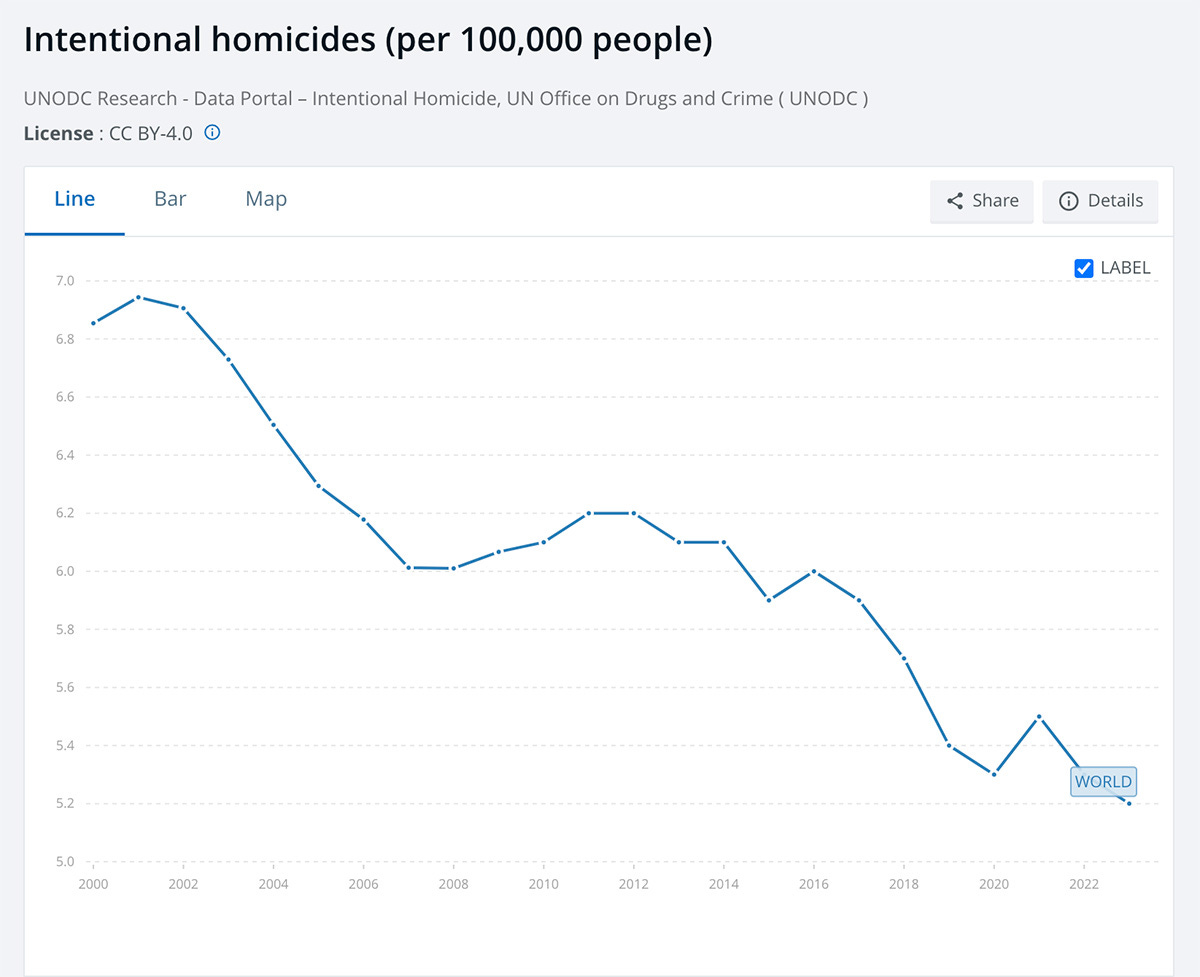
The number of homicides has risen as the global population has swelled, but as Vox’s Bryan Walsh calculates, had the rate not declined as it has, “some 1.5 million additional people would have been murdered over these years. That’s equivalent to the population of Philadelphia still breathing because the world has gotten less violent.”
As always, rates and trends differ by region and country. The Americas and Africa are much more murderous than Europe, for example, mostly because of organized crime like drug or gun trafficking and gang violence, and weak or nonexistent state capacity to respond (think Haiti or Nigeria). Some countries, like Ecuador or South Africa, have seen recent spikes in murder. There are also conflict spots where numbers are spotty at best, and since homicide data is released at a slow drip, what we’ve got so far stops in the early 2020s.
Despite localized variability, though, the United Nations predicts that the global homicide rate will continue its tumble, to around 4.6 deaths per 100,000 people, by 2030. In its latest global homicide report, the authors write that there are even “justifications” for anticipating that the decrease will carry through this century.
Some wealthier nations are experiencing a kind of generational trench across most crime types. The theory goes that Gen Z’s smartphone obsession and antisocial tendencies have made them far less criminally curious than their elders. It remains to be seen whether that pattern will hold for Gen Alpha.
But the global rate decline has less to do with theories du jour in the most peaceful nations and more to do with a handful of highly impactful megatrends. Crime is mainly a young person’s game, so as fertility rates continue to drop and the population ages, the world will literally “grow out of” crime. That’s a key part of what has happened, for example, in Brazil, which in 2024 marked its lowest number of homicides since 2012.1
We can also expect less violence in the developing world as socioeconomic opportunities increase and law enforcement and judicial capacity expands—although the UN notes that the impact of job automation and climate change might be major caveats to that progress.
We don’t generally talk about homicide as we would about, say, malaria or tuberculosis, but homicide is a top ten killer of young people 15-49. In 2022, it killed double the number of people than armed conflict and terrorism combined.2 So its downturn, especially a lasting one, is significant.
—Emma Varvaloucas
LLMs Are Antithetical to Writing and Humanity

The big brains gone wild have come bearing gifts again, this time in the form of general-purpose large language models. Where will the incipient use of LLMs as tools for writing and engaging with the human condition and experience lead us? As progress-oriented individuals, we would do well to poke around openly, dutifully, and passionately in questions such as this, and to do so now rather than later—lest we become a culture of human copies copying copies of LLM copies copying copies of human copies copying copies, ad infinitum.
By the Numbers
72%: Share of adults globally who think women in their country are treated with respect, up from 63% in 2022
23: Countries that have eliminated mother-to-child transmission of HIV and syphilis—Denmark is the latest, and the first in the EU
68: Countries that have enacted reforms to expand women’s economic opportunities since 2023
54%: Year-over-year increase in solar installations in Africa in 2025
<10: Fatal human rabies cases per year in the US, down from hundreds
Quick Hits
📉 Declining fertility rates are also a success story: A large part of the drop comes from those least likely to want or be able to provide for a baby. The teen birth rate in the US, for example, has dropped 70% since 2007.
🐔 Norway is the first country to phase out “Frankenchickens,” those selectively bred to grow ultra fast, opting instead to transition to higher-welfare breeds by 2027.
🦧 The past two decades have been a golden era of species discovery, with one study arguing that 15% of all known species have been discovered during this period. Technology and citizen scientists have sped up the process.
☀️ The global green energy transition is still happening despite the political winds against it. This year, the world may even spend more on green energy than it will on military spending.
👶 A baby boy is the first in the UK to be born from a womb donated by a dead person. The first baby born from a living womb donation was only last year.
🔋 One of the world’s largest steelmakers is trying something novel to curb emissions: a heat battery, which captures waste heat generated by steelmaking and repurposes it in the same plant.
🐘 Indonesia is the first in Asia to ban elephant rides nationwide in zoos and conservation centers. The last venues in the country to offer the rides are halting the practice under government scrutiny.
⚖️ Vietnam is the first in Southeast Asia to pass an AI law. Akin to the EU’s act, it regulates risks by requiring, among other things, that AI-generated content be labeled.
🌲 Deforestation has been reversed in Europe, North and Central America, and large parts of Asia. Though deforestation continues in many parts of the world, it is no longer inevitable.
🧫 A world-first stem cell therapy may have successfully treated babies with spina bifida in the womb. A small trial that applied stem cells to the spinal cords of six fetuses has been deemed safe for the rare but severe birth complication.
👀 What we’re watching: Congress saved foreign aid. Will the money actually get spent?
💡 Editor’s pick: An AI trio: whether it will truly cause a job apocalypse, how to stop mistaking it for a human, and the surprising effects—good and bad—it has had on the ancient game Go.
TPN Member Originals
(Who are our Members? Get to know them.)
How to think about Trump’s war with Iran | NYT ($) | Thomas L. Friedman
The US attacks Iran | Tangle | Isaac Saul
After decapitation, what’s next? | GZERO | Ian Bremmer
The Iran war and the destructiveness of Trumpism | Lucid | Ruth Ben-Ghiat
Understanding the Islamic Republic’s chain of command | Middle East Uncovered | Faisal Saeed Al Mutar
Screens are stressing you out of your mind | TFP ($) | Arthur Brooks
Must AI cure cancer? | Faster, Please! | James Pethokoukis
Dario Amodei isn’t the hero we need | NonZero | Robert Wright
In the Pentagon battle with Anthropic, we all lose | TFP ($) | Tyler Cowen
The state of the disunion | The Edgy Optimist | Zachary Karabell
The Epstein tax | No Mercy/No Malice | Scott Galloway
The article also credits the government’s security policies and two major gangs coming to an agreement over whose territory is whose.
2022, the most recent year that data is available, is unusual in that there was a surge in conflict deaths that year. Historically, the ratio between homicide and conflict deaths has been greatly lopsided. Recently, however, as the former has fallen and the latter has risen, the ratio has evened out somewhat.