

Will Pay for Happy Chickens
Poultry welfare has been quietly improving across the globe.


Welcome to What Could Go Right?, where yet another species has been declared extinct in the wild: the trophy wife.
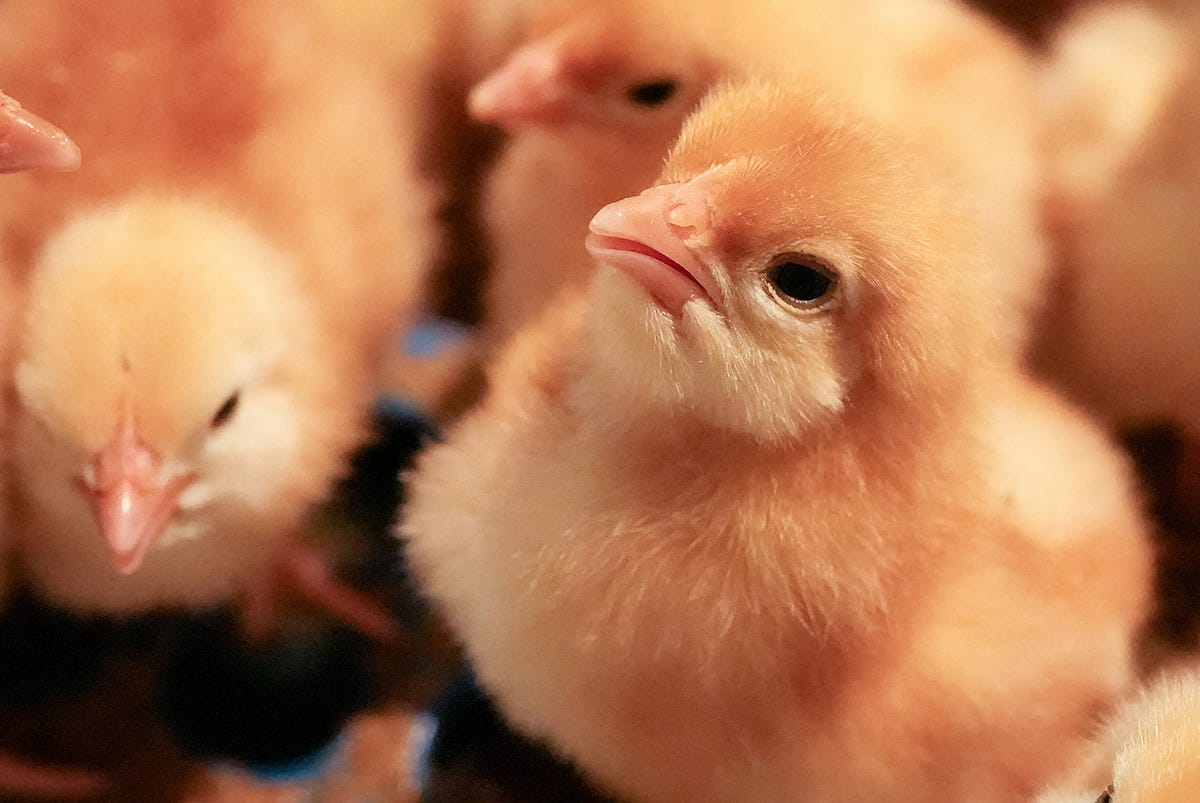
When we list the changes humanity has wrought upon the earth, those that are chicken related are not foremost among them. And yet, along with the explosion of the human population has come chickens—lots and lots of chickens.
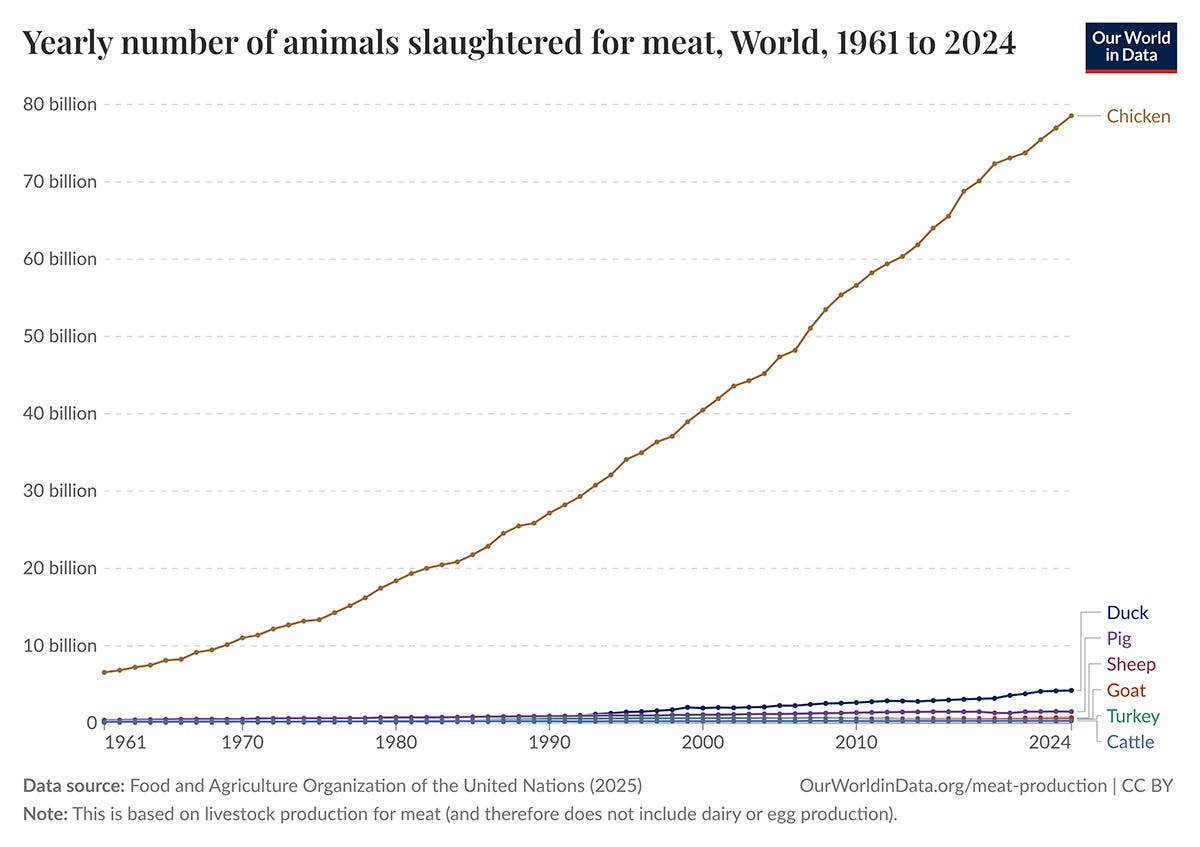
We slaughter nearly 80 billion of them every year to eat, and egg production has more than quadrupled in five decades.
Keeping up with such enormous demand has created some gnarly living conditions for the poor birds. Until about a decade ago, for instance, nearly all egg-laying hens were stuffed into cages so small that they couldn’t move or spread their wings.
Then there is the matter of the billions of hours- and day-old male chicks that are culled every year. Male chicks don’t lay eggs and are the wrong breed for meat, so they are decapitated, gassed, or shredded to death in industrial meat grinders. (I’d add a photo here of bags of adorable baby chicks waiting to be killed, but my heart cannot take it.)
Meanwhile, modern broiler chickens—those raised for meat production—are genetic anomalies. Selectively bred for decades so that they fatten up quicker, these “Frankenchickens” or “turbochickens,” as activists call them, are quadruple the weight of a typical chicken that lived 70 years ago. The fowl we eat today grow so fast that they struggle to stand under their own heft. They also experience more pain over their short lives. In the US, about 6% die before they make it to slaughter, experiencing heart failure and other health problems as their organs struggle to keep pace with their growth.
The good news is that chicken welfare is improving on all three fronts.
Thousands of companies around the world have promised to go cage-free, and unlike with many corporate commitments, they have actually followed through: The animal welfare coalition group Open Wing Alliance notes in their 2025 tracking report that cage-free supply chains are expanding particularly in Brazil, China, and Malaysia, and the global cage-free egg market is set to grow to almost $9 billion by 2034.
In the US, just under half of all hens are now in cage-free housing, up from less than 10% in 2012. It was supposed to be closer to 100% by now, but grocery stores—except Costco, Trader Joe’s, and BJ’s Wholesale, which sell exclusively cage-free eggs—have lagged behind. Advocates did cheer when America’s fourth-largest grocer announced earlier this month that it would be cage-free by 2032, after reneging on a previous pledge.
Europe, which has reached 62% cage-free housing, boasts a handful of real standouts: Sweden is 100% cage-free, and Germany is nearly so. Last year even saw the first African nation, Malawi, commit to going cage-free.
As for the culling of male chicks, technology has eliminated the need. In-ovo sexing, a technique first developed by a Dutch-German company in 2018, identifies the sex of a chicken in embryo. The hatchery can then choose to continue incubating only the females.
Of course, one challenge is implementation; in-ovo sexing is expensive to set up. That said, it cuts operational costs and is becoming cheaper by the year. It is most popular by far in Europe, where a chick-culling ban in a handful of countries—France, Germany, Austria, and by the end of this year, Italy—has given it a boost. The industry in some other countries has adopted in-ovo sexing voluntarily: The Netherlands was aiming to phase out chick culling by the end of last year, and Norway says it will by the end of this one.1
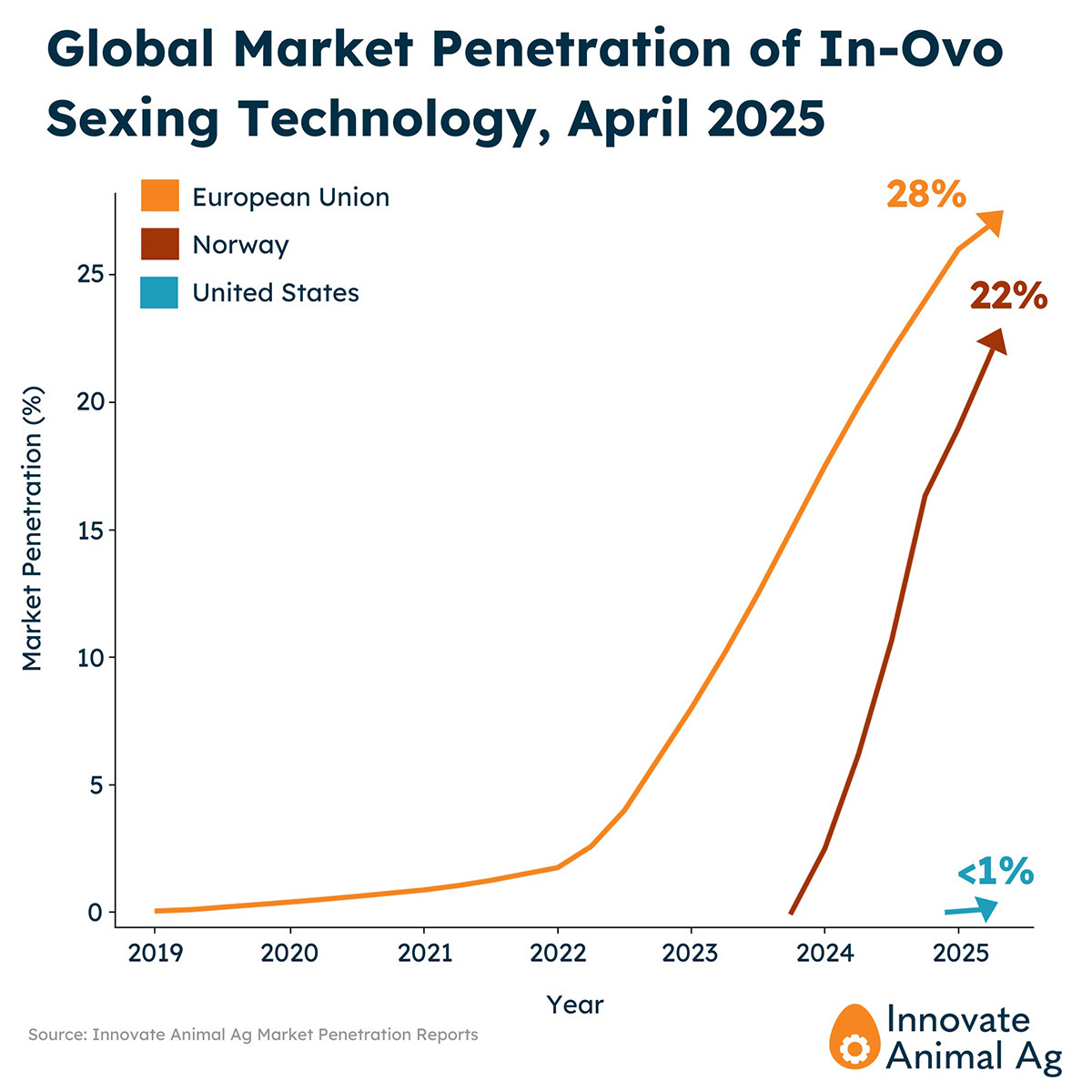
So far, the in-ovo sexing takeoff is limited to a handful of egg providers in the US, with “humanely hatched” eggs currently available from just two (see where you can buy them here). But it continues to pop up in other locations around the globe. Last year, for example, a farm in Brazil became the first in Latin America to adopt it.
Last, in recent years, hundreds of companies worldwide have signed the Better Chicken Commitment (BCC), which advocates for a switch to slower-growing breeds, among other care standards. Progress here has been uneven, with some companies declining to report transparently and others backing out completely. But many still plod along, and some are forging ahead. All fresh chicken sold in Dutch supermarkets is now slow-grown, Norway will move entirely to higher-welfare breeds by 2027, and three-quarters of French chickens live today with access to natural light, in addition to being given notably fewer antibiotics.
The real barrier is cost. The skyrocketing egg prices in the US were the result of an avian flu outbreak and inflation, not improving chicken welfare. Still, while in-ovo sexing now costs only about a cent per egg, chickens raised under BCC standards ain’t cheap. One study found that switching to slower-growing breeds would increase production costs by about 19% in the EU, making companies fidgety about reform.
Consumers across nations, however, say that they are willing to pay for happier chickens. Especially if we put our money where our mouth is, this push to expand and deepen our empathy toward the animals that sustain us says something about the quality of our global society. There is even some evidence that the more empathetic we are to animals, the more we are to our fellow humans.
—Emma Varvaloucas
By the Numbers
~70M: Child marriages averted in the past 25 years
14: Number of states that have passed paid leave laws since 2002, covering a third of the US population
90%: Slash in emissions the EU is now aiming for by 2040
7.4%: Decline in South Korea’s suicide rate, the first in three years
1600: The last year the UK saw coal use as low as it was in 2025
Quick Hits
🙅♂️ Pesticide maker Syngenta will stop producing paraquat, a weed killer linked to Parkinson’s disease. The company is facing several thousand lawsuits from litigants who allege they developed the disease after exposure to it.
🧬 Researchers have used artificial intelligence to design whole genome sequences, a step toward creating AI-generated microbial life.
🚀 NASA’s test mission to knock an asteroid off course succeeded. The agency reported last week that the asteroid is now on a slightly different route around the sun, a sign that humanity could avert a life-ending catastrophe in the future.
🇭🇷 Croatia has declared itself free of landmines, three decades after the violent breakup of Yugoslavia.
🐨 Three animal comebacks: The world’s “beefiest” parrot, which is critically endangered, is participating in a mating frenzy in New Zealand; while once-threatened koala populations in Victoria, Australia, are doing better than expected; and a butterfly once extinct in the UK has now returned.
🧑⚕️ Evidence is mounting that GLP-1 weight-loss drugs can treat addiction, too. A study of more than 600,000 people with diabetes found that those taking GLP-1s were less likely to develop a substance-abuse disorder or to be hospitalized with or overdose from one.
📱 Social media spells big business for an unlikely crop of people: African farmers. In West Africa, they are looking to TikTok for growing tips and to find customers.
🚘 Chinese automaker BYD unveiled a new battery pack that can “flash charge” in five minutes. It requires the company’s accompanying charger.
🥾 Brazil is developing its first network of hiking trails. New trails appear every day, created from the ground up by local hikers and bikers.
🧫 Japan has granted limited marketing approval to a pair of stem cell therapies—one for Parkinson’s, another for heart failure—that use pluripotent stem (iPS) cells, which can transform into any cell in the body. Japan is the first to give the go-ahead, but the arrangement is controversial.
💊 A once-daily pill for HIV patients who contracted the disease early is no longer out of reach. With a new combination drug, patients from the first decades of the outbreak can now keep the virus under control without a hard-to-follow regimen.
👀 What we’re watching: Gen Z-backed ex-rapper Balendra Shah has sailed to victory in Nepal’s parliamentary elections, but Madagascar's interim president has dissolved the government.
💡 Editor’s pick: The Ukraine war pushed Europe away from fossil fuels and toward renewables. Could the one in Iran do the same for the world?
TPN Member Originals
(Who are our Members? Get to know them.)
It’s 2028. AI has made you much happier. | TFP ($) | Arthur Brooks
Quit ChatGPT: right now! Your subscription is bankrolling authoritarianism | The Guardian | Rutger Bregman
Solar in poor countries is creating a huge lead hazard | Slow Boring | Matthew Yglesias
The midterms officially begin | Tangle | Isaac Saul
A nuclear step forward—maybe | Faster, Please! | James Pethokoukis
Iran and the immorality of OpenAI, Anthropic, and Google | NonZero | Robert Wright
The social nature of agency | Flourishing Friday | Clay Routledge
How the Iran war could consolidate China’s energy dominance | FP | Jason Bordoff
Trump has no idea how to end the war with Iran | NYT ($) | Thomas L. Friedman
Trump’s tariff pivot after SCOTUS ruling | GZERO | Ian Bremmer
TBD if the Netherlands accomplished this or not—information is scarce at the moment.
The future of chicken is related to affordable nutrition