

Covid's Quiet Retreat
The cause of a generation-defining pandemic has become just another ordinary disease.


Welcome to What Could Go Right?, where we’re delighted to announce the winner of the 2026 Capybara Long Bath Showdown, a Japanese capybara fittingly named Prune.
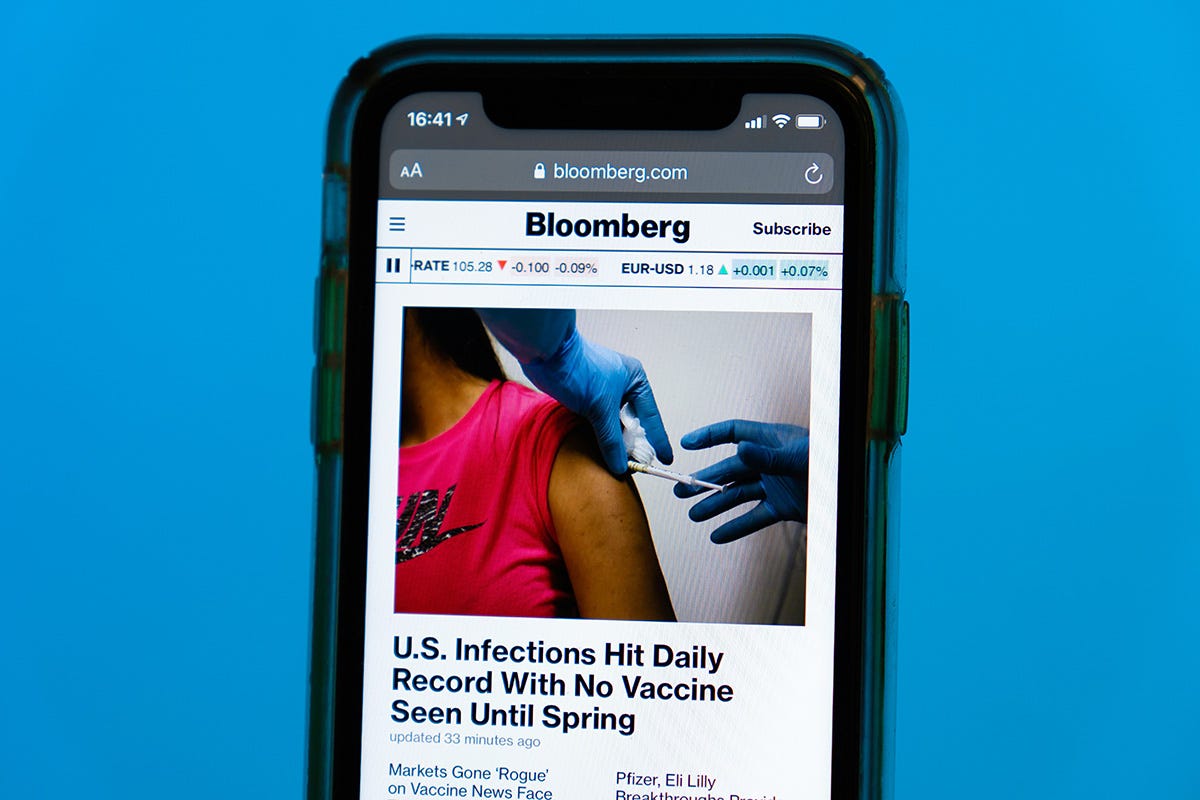
Something the progress community likes to harp on (for good reason) is how much the news shapes our perception of the world. Whatever crisis is dominating the news cycle becomes the primary lens through which we understand the “state of things,” regardless of the actual scale of its impact. Once that crisis passes, so does our attention, and we forget just how much that thing used to matter.
In a way, Covid-19 is an exception to this rule. It truly did define the state of things, everywhere, for a long while. In another way, it proves the rule. As Covid deaths have fallen dramatically, so has our interest. Judging by how little it is brought up nowadays, just a few years on from peak pandemic, it’s like it never happened.
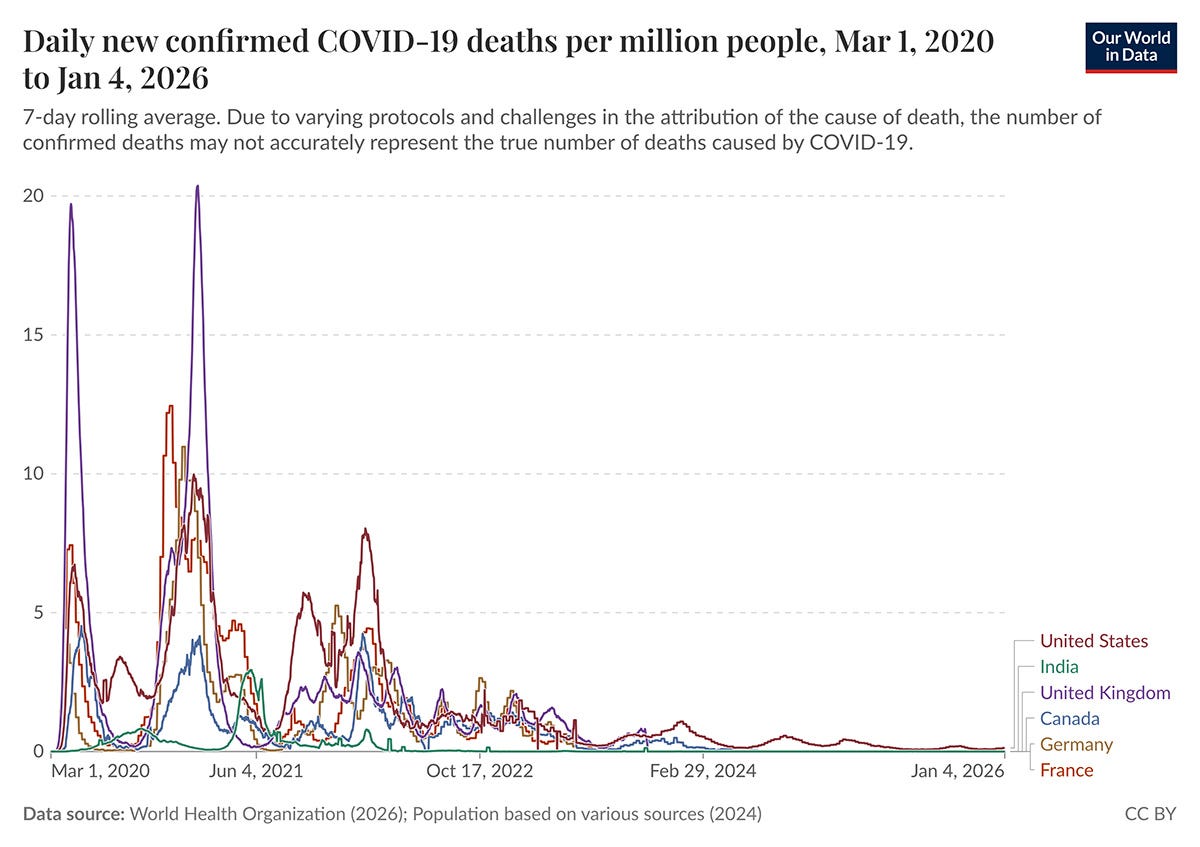
Covid has become as unremarkable to most as any other common infection. Over the holiday season, the diseases everyone was talking about in my two home countries—Greece and the United States—were norovirus and the flu. Even so, I was genuinely surprised when epidemiologist Gideon Meyerowitz-Katz collated the data for Australia and concluded that “we are now at a stage where Covid-19 is genuinely less problematic than influenza.” It’s a strange accomplishment to arrive here after all the twaddle comparing the two half a decade ago, when Covid was more dangerous by at least a factor of ten.
I was curious if his conclusion held for the States as well. We only have preliminary, widely ranging estimates for the 2024–2025 flu season. But we can say that there were roughly 2-3x the number of flu to Covid hospitalizations and about five times the number of flu infections, comparing the low and high ends of each estimate to one another. On the low end, death counts were about equal, but on the high end, flu deaths were more than double.
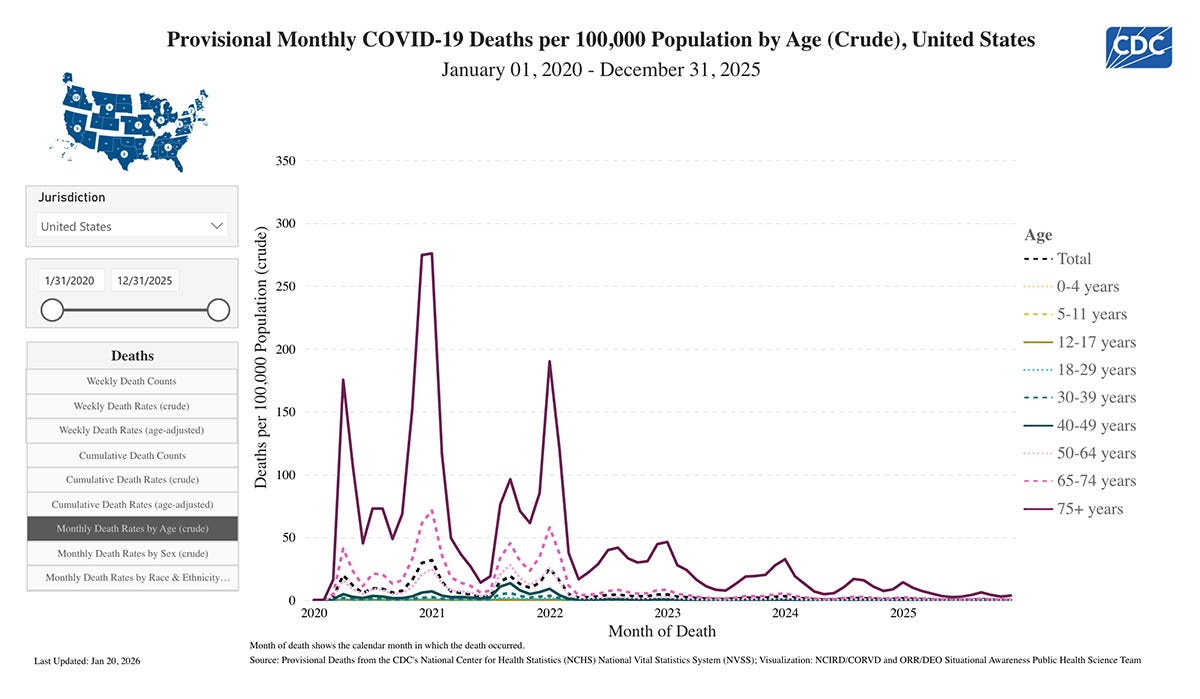
And unlike the flu, Covid death rates (and numbers) continue to drop over time, including this current season. For anyone under 75, they’re essentially at zero:
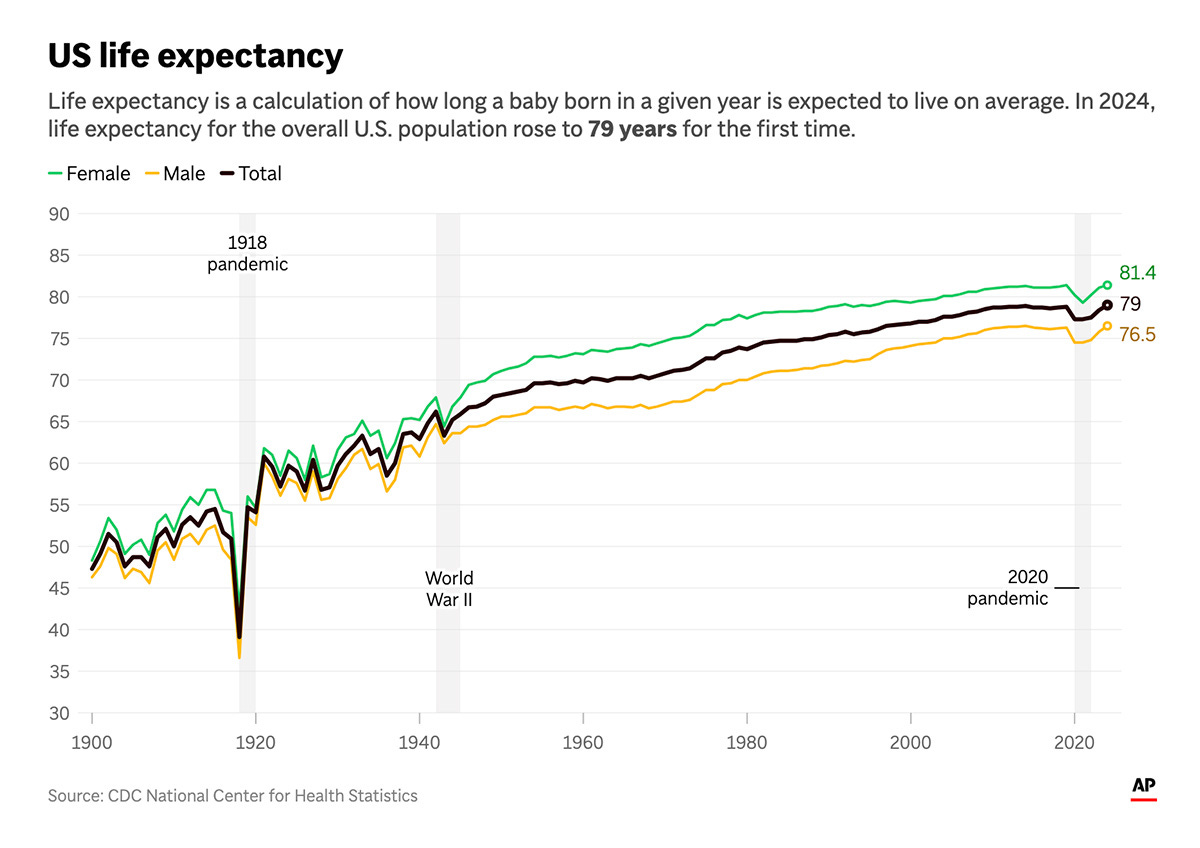
Covid’s retreat has also helped bring American life expectancy to an all-time high of 79, a recovery far less heralded than its dip had been lamented. Deaths from heart disease, cancer, and drug overdoses have also ebbed.1 Covid was the No. 3 killer in 2020, but has now slipped out of the top 10; an American is more likely to die these days from cirrhosis or suicide. CDC statistical analysis chief Robert Anderson told the Associated Press that he expects the improvement to continue, so the data for 2025 may be record-breaking as well.2
I was also genuinely surprised to see the World Health Organization’s substantial list of beefed-up pandemic preparedness that it released this week. It includes a major international agreement, a surveillance network to track pathogens boosted by artificial intelligence, a global health emergency corps, a training hub for biomanufacturing, and a lot more—a global cooperation opportunity that the US will mostly miss out on, now that it has officially withdrawn from the organization.
Of course, there are plenty of ways that Covid is still with us. Long Covid, for instance, has become no less of an issue for those stricken by it, even as it has become less prevalent. (Although a battery of clinical trials for it that have begun in recent years, including some for children, will hopefully provide answers and treatments one day.) Likewise, the economies of some low-income nations never bounced back from the pandemic years. And one can only pray that the Trump administration’s decision to withdraw from the WHO will be reversed by the next one.
But for the most part, I take it as a sign of psychological health—and a personal assessment of risk that actually aligns with the data—that Covid has largely dropped off our radar.3 It’s a future that not too long ago felt lifetimes away.
—Emma Varvaloucas
By the Numbers
10: Number of human guinea worm cases in 2025, the least ever recorded
50%: Share of electricity in Australia generated by renewables in December 2025, a clean energy milestone for the country
18,041: Number of fast-charging ports added in the US last year, a 30% expansion
31%: Share of Pakistanis who think living standards are improving, a sign of optimism in a country that sat in the global bottom of the same measure a few years ago
Quick Hits
🫁 A patient survived for 48 hours without both of his lungs through the aid of an artificial lung system, long enough to receive a lung transplant.
⚡ Ten European countries have agreed to build a vast offshore wind network in a bid to reduce the bloc’s reliance on imported Russian gas.
🌲 Deforestation appears to have fallen in Colombia last year, particularly in its hardest-hit areas, a sign that efforts to address long-standing drivers are working.
🐻❄️ A new study complicates the story that polar bears are universally threatened by melting sea ice, finding that polar bears in Svalbard, Norway, are healthy. The bears seem to be adapting their diet in response to rapid ice loss.
🌊 A first-of-its-kind underground hydropower system has begun operating in England. The technology allows the storage of energy produced through hydropower without the need for traditional dams.
👨 American men are much more open to trying birth control, an unanticipated result of the Dobbs decision in 2022. Three options are a few years away from commercialization.
📉 Bogotá, Colombia, is changing its reputation as one of Latin America’s most polluted cities through the unusual strategy of targeting the poorest, most polluted neighborhoods first. The introduction of clean air zones has slashed air pollution 24% between 2018 and 2024.
🧑🎓 Reported depression, anxiety, and suicidal thoughts fell for the third year in a row for American college students. And Yale is waiving all costs for families making less than $100,000 a year, joining other Ivy League institutions that have made similar moves.
⚖️ A judicial misconduct complaint lodged by the Department of Justice against a DC federal judge has been dismissed for lack of evidence. The judge had repeatedly ruled against the Trump administration in the case of Venezuelan migrants deported to El Salvador.
👀 What we’re watching: Homelessness may have declined in the US last year.
💡 Editor’s pick: You can lead a kid to AI, but apparently you can’t make them like it. And, what is really happening on Moltbook, the social media network for AI agents?
TPN Member Originals
(Who are our Members? Get to know them.)
The message from Texas voters: We’re neighbors, not enemies | NYT ($) | Thomas L. Friedman
Good Trump-related news! | NonZero | Robert Wright
Look in the mirror | The Edgy Optimist | Zachary Karabell
History shows Trump’s worst impulses may backfire on him | NYT ($) | Ruth Ben-Ghiat
If court orders don’t matter, nothing does | The Preamble | Sharon McMahon
Gaza peace plan enters phase two | Tangle | Isaac Saul
Tripolar tussles | Diane Francis | Diane Francis
Can AI help us find God? | TFP ($) | Tyler Cowen
Can AI make us more open-minded? | Flourishing Friday | Clay Routledge
What to know about China’s military purges | GZERO | Ian Bremmer
Family estrangement is a tragedy | TFP ($) | Arthur Brooks
Interestingly, the heart disease declines are chalked up to medical advances and . . . weight management! GLP-1s strike again?
For those distrustful of health data at the moment, the man has been with the CDC for nearly 30 years.
As Meyerowitz-Katz writes, “ . . . it’s perfectly rational for the average person to treat Covid-19 in the same way they treat adenovirus, RSV, and influenza. You might not want to catch them, but most people probably don’t need to factor them into everyday life, either.”
Really solid analysis on the data shift. The comparison to flu now being more dangerous is wild considering where we were in 2020. I've noticed hospitals in my area have quietly dismantled most of their COVID protocols over the past year which aligns with thes numbers. The part about life expectancy hitting 79 is especially under-reported compared to how much coverage the decline got.